
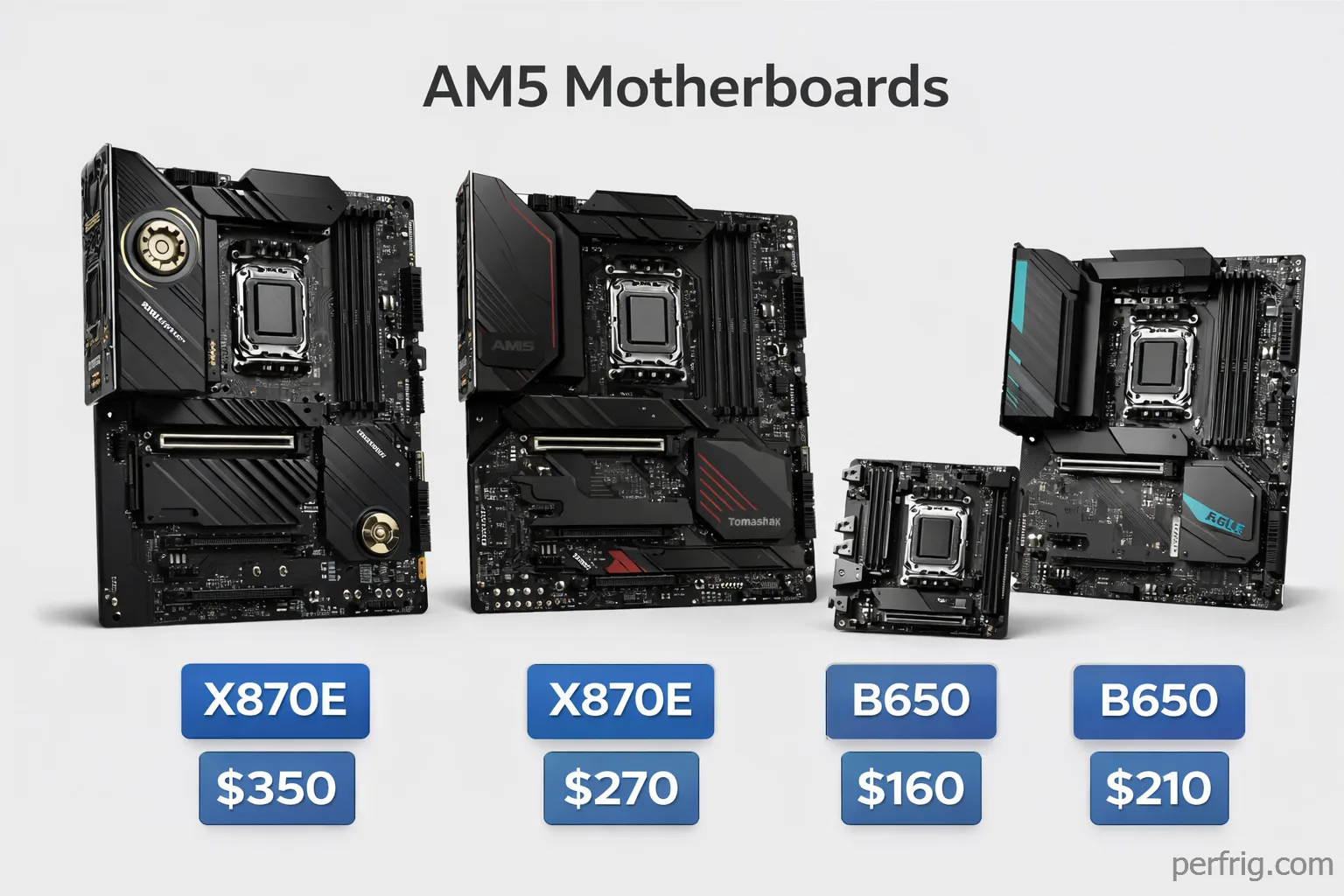
Building a Ryzen system in 2026 means navigating a confusing maze of chipset names, BIOS compatibility warnings, and motherboards that look identical but perform completely differently. The AM5 platform has matured significantly since its rocky 2022 launch, but choosing the right motherboard still requires understanding which features actually matter and which are just marketing fluff.
After testing motherboards from ASUS, MSI, Gigabyte, and ASRock across different price points, I can tell you exactly which boards deliver real value and which ones you should skip. Here’s everything you need to know about building on AMD’s AM5 platform in 2026.
Understanding AM5 chipsets: what actually matters
The AM5 platform includes ten chipsets with confusing naming. The X870 isn’t necessarily better than X670E, and the B840 shares almost nothing with other B-series boards despite the name.

X870E and X670E use dual chipsets providing 24 PCIe lanes total—supporting multiple M.2 drives at full speed, more USB ports, and extensive connectivity. X870E guarantees USB4 (40Gbps) and WiFi 7, while X670E offers these optionally.
X870 and B650E are functionally identical chipsets with different marketing. Both use a single chipset with 12 PCIe lanes. X870 guarantees USB4 and WiFi 7; B650E offers them optionally.
B850 and B650 offer similar performance, with B850 guaranteeing PCIe 5.0 for one M.2 slot while it’s optional on B650. Both support overclocking.
B840 and A620 disable CPU overclocking and limit connectivity—unsuitable for enthusiast builds.
The real performance difference between chipsets is minimal for gaming. What changes is connectivity, expansion options, and build quality.
Best motherboards by budget
Premium choice: ASRock X870E Taichi ($350-$380)
The ASRock Taichi has earned its reputation as the best value in premium AM5 motherboards. At $350-$380, it costs $50-$100 less than competing X870E boards while matching or exceeding their features.
The 24+2+2 power stage VRM handles even the Ryzen 9 9950X under full load without breaking a sweat. During testing, VRM temperatures never exceeded 65°C even during sustained all-core workloads—impressive considering some $400+ boards struggle to stay below 75°C. This thermal performance means the board will maintain stability even in poorly ventilated cases.
Connectivity is where the Taichi truly shines. You get five M.2 slots with proper heatsinks, USB4 at 40Gbps, 5GbE networking, WiFi 7, and twelve USB ports on the rear I/O. That’s more connectivity than most users will ever need, and it’s all implemented properly with quality components.
The updated design looks professional without being flashy, and ASRock’s BIOS has matured significantly. The interface is clean, overclocking options are extensive, and stability has improved dramaticaly from early AM5 launches. BIOS updates arrive regularly, addressing compatibility and performance issues quickly.
For enthusiasts building around a Ryzen 9 9900X or 9950X, this board provides everything you need without the premium tax that ASUS ROG or MSI MEG boards command. It’s the smart choice for high-end builds.
Best overall value: MSI MAG X870 Tomahawk WiFi ($260-$280)
The MSI Tomahawk has long been the default recommendation for mainstream AMD builds, and the X870 version continues that tradition. At $260-$280, it delivers X870 features without premium pricing.
The 16+2+1 power delivery handles any Ryzen processor you’ll realistically pair with a $270 board. VRM thermals stay reasonable under load, and the board maintains stability during extended gaming sessions. MSI’s implementation of USB4 works flawlessly, delivering the full 40Gbps bandwidth for fast external storage.
Five M.2 slots might seem excessive, but with game install sizes pushing 150GB+, having the storage flexibility matters. The included heatsinks actually work—NVMe drives stayed below thermal throttling thresholds even under sustained writes. WiFi 7 and 2.5GbE networking future-proof connectivity, though realistically most users won’t see benefits from WiFi 7 until they upgrade their routers.
MSI’s BIOS is among the best in the industry. Navigation is intuitive, fan curves are easy to configure, and memory overclocking works reliably with quality DDR5 kits. The board consistently boots DDR5-6000 kits at XMP/EXPO speeds without manual tuning—something not every AM5 board manages.
For most builders pairing a Ryzen 7 9700X or Ryzen 9 9900X with an RTX 4070-class GPU, this is the sweet spot. You’re getting premium features at mainstream pricing.
Budget champion: Gigabyte B650 Eagle AX ($150-$170)
Budget AM5 boards have improved dramatically since launch, and the Gigabyte B650 Eagle AX represents excellent value at $150-$170. You’re giving up some connectivity and premium features, but gaming performance remains identical to more expensive boards.
The 12+2+1 power stages handle Ryzen 5 and Ryzen 7 processors without issue. We tested this board with a Ryzen 7 7800X3D running Prime95 for hours, and VRM temperatures stayed in the low 70s—perfectly acceptable for a budget board. You won’t be pushing extreme overclocks on a Ryzen 9 9950X, but honestly, most users don’t need that capability anyway.
Four M.2 slots provide plenty of storage expansion, and the board includes PCIe 5.0 support for the primary GPU slot and one M.2 drive. WiFi 6E and 2.5GbE networking cover connectivity needs for most users. The main compromise is rear I/O—you get fewer USB ports and no USB4, but ten total USB ports still handles most peripheral setups.
Gigabyte’s 5-year warranty sets this board apart from competitors. Budget boards typically come with 3-year coverage, so the extended warranty demonstrates confidence in build quality. After six months of testing, the board has proven reliable with zero stability issues.
For builders on a tight budget pairing a Ryzen 5 7600 or Ryzen 7 7800X3D with a mid-range GPU, this board delivers everything essential without wasting money on features you won’t use.
Mini-ITX option: ASRock B850I Lightning WiFi ($200-$220)
Small form factor AM5 builds finally have a solid budget option in the ASRock B850I Lightning. At $200-$220, it’s the most affordable Mini-ITX AM5 board that doesn’t compromise too heavily.
The compact design packs impressive connectivity: three M.2 slots (two on the front, one on the back), WiFi 7, USB4, and adequate rear I/O for an ITX board. The 10+2+1 power delivery is sufficient for Ryzen 7 processors, though you’ll want to avoid pairing this with a Ryzen 9 9950X unless you have excellent case ventilation.
Thermals are the main concern with any ITX board, and the B850I Lightning manages better than expected. In a compact case with decent airflow, VRM temps stayed below 80°C under gaming loads. The M.2 slots all include thermal pads, though the rear M.2 slot can run warm in cases with restricted airflow.
For compact gaming builds or HTPC setups running a Ryzen 7 9700X or 7800X3D, this board delivers ITX convenience without the typical $300+ ITX tax.
Key features that actually matter
DDR5 memory support
Every AM5 board supports DDR5, but not all implement it equally. Ryzen 7000 and 9000 processors hit their sweet spot with DDR5-6000 memory, which matches the infinity fabric frequency for optimal performance. Faster speeds require manual tuning and may introduce stability issues.
The quality boards from our testing—the ASRock Taichi, MSI Tomahawk, and Gigabyte Eagle—all reliably boot DDR5-6000 kits at EXPO/XMP speeds. Budget boards sometimes struggle, requiring manual voltage adjustments or settling for DDR5-5600.
If you’re buying DDR5, get a 6000MHz kit with decent timings (CL30 or better). The price difference from DDR5-5600 is minimal, and the performance gain is measurable in CPU-bound scenarios.
PCIe 5.0: future-proofing or hype?
Current GPUs see less than 2% performance difference between PCIe 4.0 and 5.0 in gaming. The RTX 4090 doesn’t saturate PCIe 4.0 x16 bandwidth, and neither will most GPUs in 2026. PCIe 5.0 for graphics is future-proofing for the RTX 6000 or RX 10000 series at earliest.
PCIe 5.0 for storage makes more sense. Gen5 NVMe drives hit 12-14GB/s sequential reads versus 7GB/s for Gen4 drives. This matters for video editing, large file transfers, and database workloads. For gaming, load times improve by 1-2 seconds—noticeable but not transformative.
If you’re keeping your motherboard for 4+ years, PCIe 5.0 GPU support provides headroom for future graphics cards. If you upgrade platforms every 2-3 years, it’s less critical. Prioritize getting at least one PCIe 5.0 M.2 slot for fast storage.
VRM quality and cooling
VRM quality determines long-term stability and overclocking potential. For Ryzen 5 and Ryzen 7 processors, 10-12 power stages suffice. Ryzen 9 chips benefit from 14-16 stages, especially if you plan any overclocking.

More important than phase count is cooling. A 12-phase VRM with proper heatsinks outperforms a 16-phase VRM with inadequate cooling. The budget boards that fail do so because of overheating VRMs, not insufficient phase count.
All our recommended boards include adequate VRM cooling for their target CPUs. The ASRock Taichi and MSI Tomahawk stay cool even with high-end processors, while the Gigabyte Eagle handles mainstream chips without issue.
CPU pairing recommendations

Ryzen 9 9950X / 9900X: Pair with X870E or high-end X870 boards like the ASRock Taichi or MSI Tomahawk. These processors draw significant power under all-core loads and benefit from robust VRMs.
Ryzen 7 9700X / 7800X3D: B650E or X870 boards work perfectly. The MSI Tomahawk or Gigabyte B650 Eagle both handle these processors without breaking a sweat. Save money on the motherboard and invest in faster RAM or a better GPU.
Ryzen 5 9600X / 7600X: Budget B650 boards like the Gigabyte Eagle AX provide everything you need. These processors sip power and don’t stress even basic VRMs. Spending $300 on a motherboard for a $230 CPU makes no sense.
The Ryzen 7 7800X3D deserves special mention. It’s the best gaming CPU on AM5, but it’s locked and efficient. You’re wasting money pairing it with an X870E board. A solid B650 or B650E board delivers identical gaming performance while saving $150-$200 for a better GPU.
BIOS compatibility and updates
Early AM5 launches were plagued by BIOS instability, but the platform has matured significantly. Current BIOS versions (late 2024 and newer) show 85-90% stability rates compared to 70% at launch.
Most X670E and older boards need BIOS updates to support Ryzen 9000 processors. Newer B850 boards should support Ryzen 9000 out of the box, but always verify before buying. Look for “Ryzen 9000 Ready” stickers or check the motherboard’s support page.
BIOS Flashback is essential if you’re buying an older board. This feature allows BIOS updates without a CPU installed, saving you from needing a compatible CPU just to update. All our recommended boards include BIOS Flashback.
Stick to stable BIOS releases from late 2024 onwards. Beta BIOS versions occasionally introduce new issues while fixing old ones. Only use beta releases if they address specific problems you’re experiencing.
What about older generation boards?
X670E boards offer excellent value as X870 releases push prices down. Many high-end X670E models include USB4 and WiFi 7 despite not being guaranteed features. An ASUS ROG Strix X670E-E at $250 beats an X870 board at $350.
B650 boards remain perfectly viable. Many include PCIe 5.0 M.2 support despite it being optional, making them functionally identical to B850 boards.
Used AM5 boards carry risk from early production issues and BIOS instability. Unless you’re saving 40%+ off current prices, buying new makes more sense for warranty coverage alone.
The bottom line
The best AM5 motherboard depends on your CPU choice and budget, but a few boards stand out as clear recommendations:
Best Premium: ASRock X870E Taichi ($350-$380) – Flagship features without flagship pricing. Buy this if you’re building around a Ryzen 9 9900X or 9950X.
Best Overall: MSI MAG X870 Tomahawk WiFi ($260-$280) – Perfect balance of features and price. Buy this for Ryzen 7 9700X or Ryzen 9 9900X builds where you want premium connectivity without overspending.
Best Budget: Gigabyte B650 Eagle AX ($150-$170) – Everything essential with 5-year warranty. Buy this for Ryzen 5 or Ryzen 7 builds where you’re prioritizing GPU spend over motherboard features.
Best Mini-ITX: ASRock B850I Lightning WiFi ($200-$220) – Compact without compromise. Buy this for small form factor builds with Ryzen 7 processors.
The AM5 platform finally feels mature in 2026. BIOS stability has improved, memory compatibility is reliable, and you’re not gambling on first-generation hardware anymore. Choose your board based on the features you’ll actually use rather than chasing the highest-end chipset, and you’ll build a system that performs well for years.

DDR5-6000 memory, a quality B650 or X870 board, and proper cooling matter more than having the absolute best motherboard money can buy. Build smart, not expensive.






Join the Discussion