
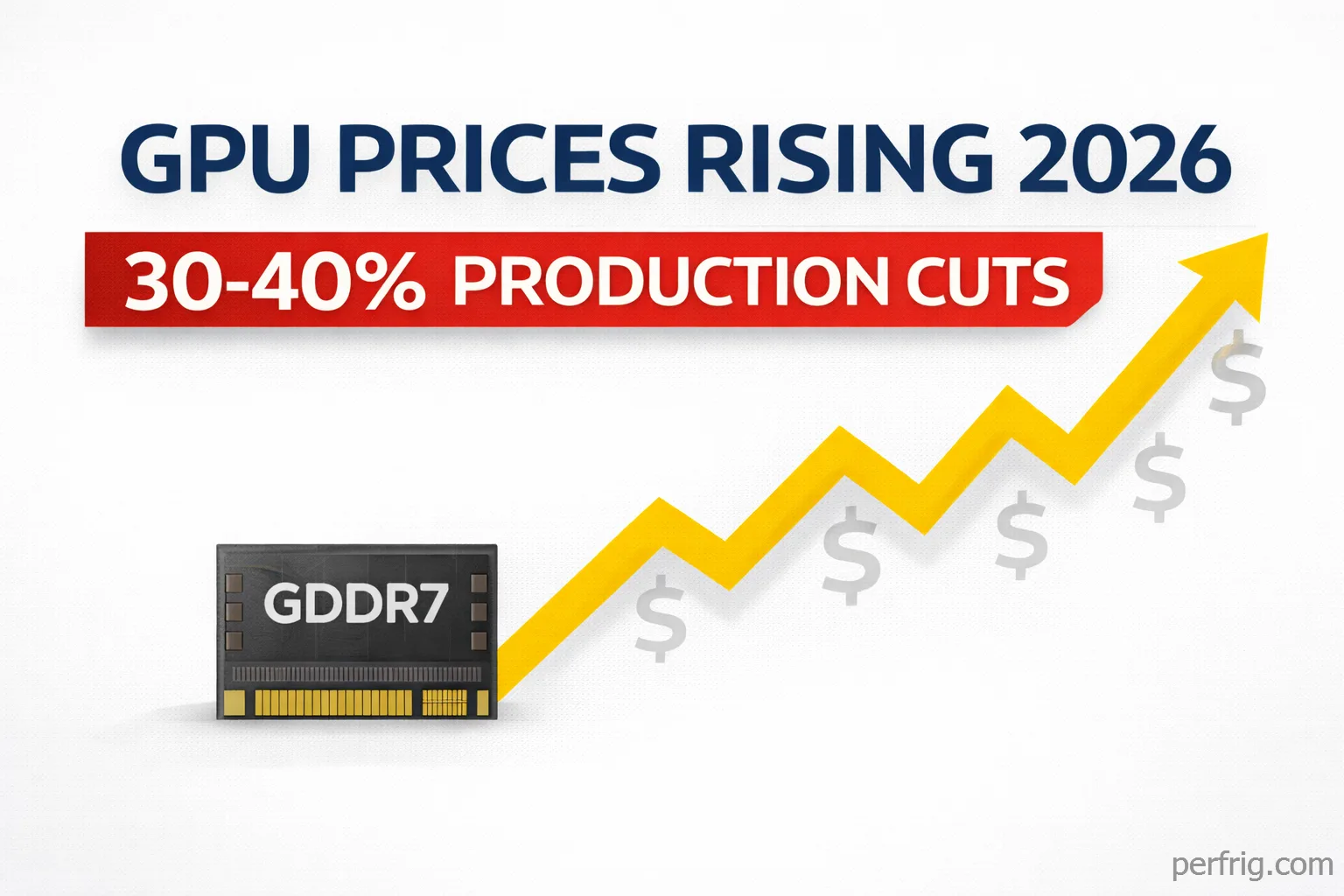
GPU prices are surging in 2026 as memory shortages force major production cuts and price increases. NVIDIA plans to slash GeForce RTX 50 series production by 30-40% in H1 2026, while AMD prepares price hikes starting this month. AI data centers are consuming memory at unprecedented rates, leaving gamers competing for scraps.
The Memory Shortage: AI Takes Priority
GDDR7 memory powering RTX 5000 cards faces severe constraints. Samsung and SK Hynix prioritize AI accelerators over consumer GPUs—products generating far higher margins. Memory now represents 80% of GPU manufacturing costs, meaning even small increases cascade into retail pricing.
AI data centers consume roughly 70% of GDDR7 production, leaving gaming GPUs with just 30%. DDR5 system memory faces identical pressures after Micron discontinued its Crucial brand to focus on AI production. DDR5 prices doubled throughout 2025, with further increases coming.

NVIDIA Cuts Production 30-40%
Board Channels reports indicate NVIDIA informed partners of major cuts weeks ago. H1 2026 supply will drop 30-40% compared to H1 2025. RTX 5070 Ti and RTX 5060 Ti 16GB face the deepest reductions—both use 16GB GDDR7 like the RTX 5080 but sell for half the price.

The RTX 5060 Ti 16GB represents the sweet spot for 1440p gaming. Its removal creates a gap between VRAM-limited 8GB models and expensive high-end cards. NVIDIA’s RTX PRO lineup faces no cuts, as professional cards command premium pricing.
AMD Raises Prices Too
AMD’s RDNA 4 uses GDDR6 rather than GDDR7, providing slight insulation. However, AMD isn’t immune—the company informed partners that memory costs necessitate price increases starting January 2026.
The RX 9070 XT launched at $600 but maintaining that price looks increasingly difficult as memory costs climb. Previous-gen RX 7000 cards use the same GDDR6, creating internal competition for limited supply.
Timeline: When Prices Jump
AMD increases begin in January. NVIDIA follows in February. Expect 10-20% increases for most models by mid-2026. An RTX 5070 at $550 could hit $650-$700 by summer. The RTX 5060 Ti 16GB might jump from $420 to $500+.

Current inventory represents the last chance at 2025 pricing. Previous-gen cards aren’t immune either—as new-gen prices rise, manufacturers adjust older inventory upward. ASUS already confirmed increases effective January 5, 2026.
RTX 50 Super: Delayed or Dead
NVIDIA’s CES 2026 keynote skipped Super variants entirely, breaking a five-year pattern. Rumored specs call for 3GB GDDR7 modules instead of standard 2GB chips, enabling higher VRAM—an RTX 5070 Super with 18GB versus 12GB.
The problem: 3GB modules barely exist. Samsung produces limited quantities for laptops only. Desktop volumes appear impossible given current constraints. If Super cards launch at all, expect Q3-Q4 2026 with limited availability at premium pricing. Some analysts predict outright cancellation.
What Gamers Should Do
Act now. Current inventory offers the best pricing you’ll see for months. Previous-gen cards deliver strong value—RTX 4070, 4070 Ti, and 4080 perform excellently at prices more reasonable than RTX 50 series will become. AMD’s RX 7800 XT and RX 7900 XT use older GDDR6, providing insulation from GDDR7 shortages.
The 8GB versus 16GB decision matters more than ever. While 8GB models stay more available, modern games increasingly demand more VRAM. Buying 8GB means earlier replacement.
Consider pre-built systems from major manufacturers. They secure GPU inventory months ahead through volume contracts, potentially offering better value than DIY builds in constrained markets.
When Does This End?
Memory shortages persist through 2026 into 2027. GDDR7 production ramps slowly due to manufacturing complexity and AI competition. Supply-demand balance won’t restore until late 2027 minimum.
AI boom trajectory determines timelines. Major tech companies show zero signs of reducing infrastructure investment, suggesting continued memory pressure. This crisis resembles the 2021-2022 crypto boom but may last longer—demand comes from established corporations, not speculative markets.
The Bottom Line
GPU prices rise throughout 2026 due to AI-driven memory shortages. NVIDIA’s 30-40% cuts and AMD’s increases will push prices 10-20% higher by mid-2026 while limiting availability. RTX 50 Super faces delays or cancellation.
Act quickly to buy current inventory. Previous-gen cards offer better value than new releases will. The window for reasonable pricing closes rapidly.
Memory constraints persist into 2027, keeping prices elevated and supply limited. Gaming and AI compete for identical components, and AI wins overwhelmingly. Building a gaming PC in 2026 costs more and involves more compromise than any point in the past decade.
The golden age of GPU availability from 2023-2024 is over. The constrained market of 2026-2027 represents the new normal gamers must navigate. Buy now or pay significantly more later—those are the only options.







Join the Discussion