
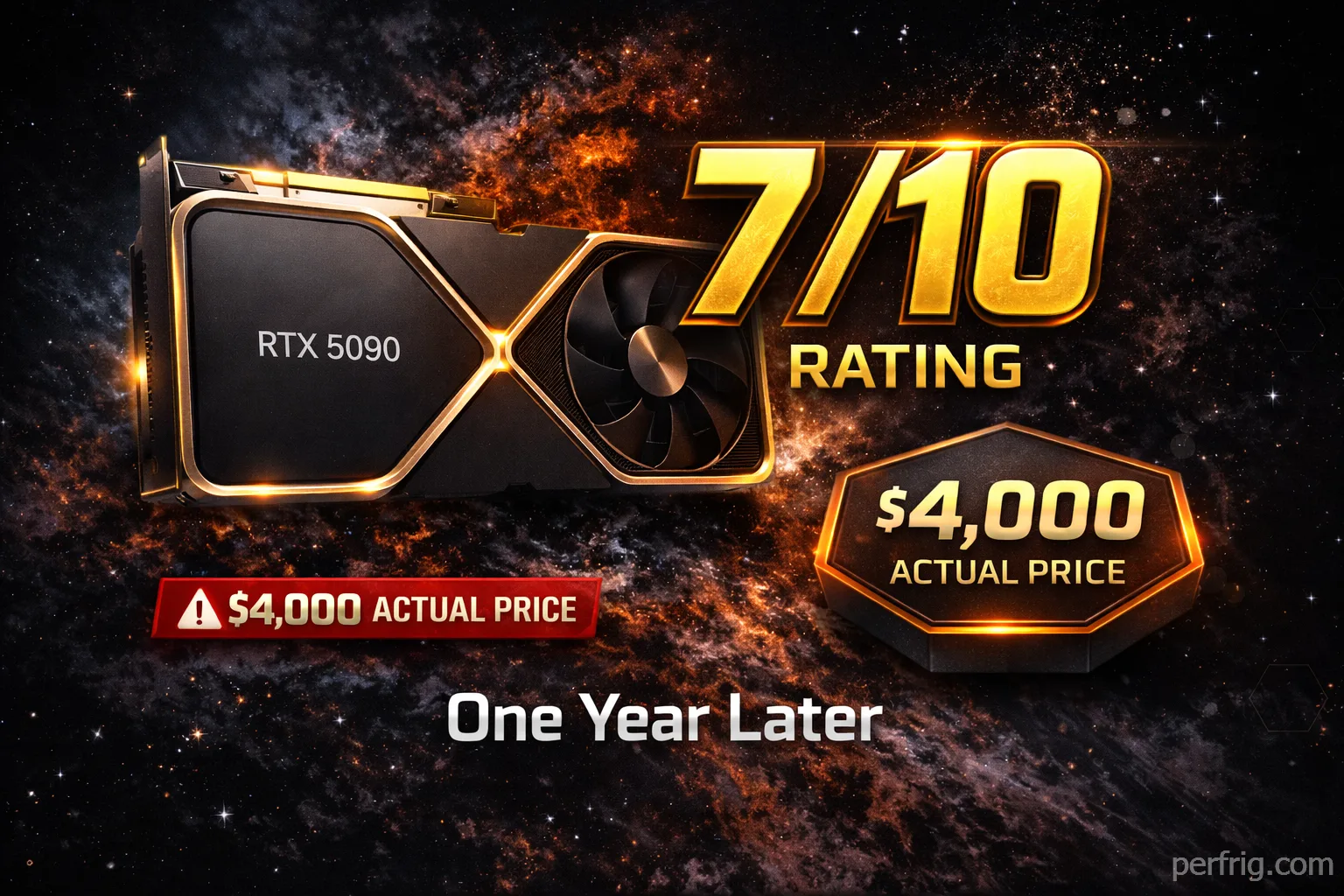
Look, the RTX 5090 launched a year ago with massive hype and even bigger promises. NVIDIA claimed 2x performance over the 4090, revolutionary AI features, and next-gen gaming. The reality? You can’t buy one at MSRP, prices hit $4,000, and the actual performance gains depend heavily on AI frame generation rather than raw power.
After a full year in the wild, here’s the real talk on whether the RTX 5090 deserves your money—if you can even find one.
Rating: 7/10 – Powerful but plagued by availability and pricing disasters
What You’re Supposed to Get
The RTX 5090 packs genuinly impressive specs on paper. NVIDIA built this thing on TSMC’s 4nm process with 92.2 billion transistors—a monster compared to the RTX 4090’s already-huge design.
Specs breakdown: 21,760 CUDA cores across 170 streaming multiprocessors, 32GB of GDDR7 memory on a 512-bit bus, 1,792GB/s of memory bandwidth. That’s 82.58 TFLOPS of compute power, which sounds incredible until you realize it requires a 1,000W PSU and pulls 575W under load.
The RTX 5080 uses the smaller GB203 die with 10,752 CUDA cores and 16GB GDDR7. Power draw hits 360W, needing an 850W PSU minimum.
Both cards feature fourth-gen RT cores for ray tracing and fifth-gen Tensor cores for AI workloads. The headline feature: DLSS 4 with Multi Frame Generation, creating up to three interpolated frames between rendered frames.
Here’s the thing—those specs look amazing in press releases. Actually getting your hands on one? That’s where everything falls apart.
The Launch Disaster
NVIDIA announced the RTX 5090 at $1,999 and the 5080 at $999 on January 30, 2025. Both sold out globally within 5 minutes. Partner cards from ASUS, MSI, and Gigabyte vanished equally fast, with retailers receiving 3-5 units per shipment.
That shortage never improved. Throughout all of 2025, the RTX 5090 stayed virtually impossible to buy at MSRP. NVIDIA’s Founders Edition drops through their Verified Priority Access program represented the only way to snag one at list price—if you won the lottery and happened to be online at the right moment.
The RTX 5080 did slightly better, restocking every 2-4 weeks, but partner cards consistently sold for $1,200-$1,400 instead of $999. By mid-2025, average pricing hit $1,515—a 52% markup over MSRP.
Fast forward to January 2026: RTX 5090 prices approached $4,000 at major retailers. Only NVIDIA’s direct sales maintained $1,999 for the handful of Founders Editions that trickled out monthly.
Bottom line: you can’t review a product nobody can actually buy. That’s the RTX 5090’s biggest problem right there.
Performance: Good, But Not What They Claimed
NVIDIA’s marketing screamed “2x faster than RTX 4090” at every opportunity. That number relies entirely on DLSS 4 Multi Frame Generation running in 4x mode—not actual hardware performance.

Real gaming benchmarks without frame generation? The RTX 5090 delivers 30-40% improvements over the 4090 at 4K. That’s solid, impressive even, but nowhere near doubling performance. The RTX 5080 shows 10-15% gains over the 4080 in pure rasterization.
Games like Cyberpunk 2077, Starfield, and Alan Wake 2 show the 5090 crushing 4K max settings at 80-100 FPS native—no upscaling needed. That’s genuinely faster than anything before it. But the 4090 hits 60-75 FPS in the same scenarios, and most gamers can’t tell the differance between 75 and 95 FPS at that resolution.
DLSS 4 Multi Frame Generation does provide massive frame rate boosts—3-8x in supported titles. Turn it on in Cyberpunk with path tracing, and you’ll see 200+ FPS on a 4K monitor. The catch: it introduces 20-30ms of additional latency. That’s unusable for competitive gaming where every millisecond matters. You’re essentially trading responsiveness for higher numbers on an FPS counter.
The frame generation also creates artifacts during rapid camera movement. It’s fine for single-player exploration games, but fast-paced action titles show the AI struggling to keep up. You’ll notice ghost images and smearing when whipping the camera around quickly.
Ray tracing performance improved more convincingly. The RTX 5090’s fourth-gen RT cores deliver 50-60% gains in path-traced titles like Cyberpunk 2077 running RT Overdrive mode. If you’re chasing maximum ray tracing eye candy, the 5090 genuinely excels here. Path tracing finally becomes playable at 4K without feeling like a slideshow.
Real talk: NVIDIA shifted from selling hardware performance to selling AI-generated frames. The card is fast, but not revolutionary without DLSS doing heavy lifting. And that’s fine for single-player games where latency doesn’t matter—but it’s misleading marketing when comparing generation-over-generation improvements.
The $4,000 Question: Pricing Insanity
The $1,999 MSRP became a joke within months. By June 2025, average pricing hit $2,499. October saw listings at $3,000-$3,500. January 2026 brought us to nearly $4,000 at major retailers.

Why? Multiple factors colliding simultaneously. NVIDIA prioritized AI datacenter chips over consumer GPUs—same 4nm process, way higher profit margins. The DRAM shortage reduced GDDR7 availability. Retailers knew customers had zero alternatives and priced accordingly.
Some analysts speculated NVIDIA might officially raise MSRP to $5,000. That never happened, but it didn’t matter—retailers charged whatever they wanted anyway.
The RTX 5080 suffered similar inflation, settling around $1,360 by December 2025. That’s a 36% premium over MSRP, less extreme than the 5090 but still rough.
Compare this to the RTX 4090 sitting at $1,600-$1,800 and actually being in stock. The 4090 delivers 75% of 5090 performance for less than half the real-world price. That math doesn’t work in the 5090’s favor.
Technical Problems: Rough First Year
Supply wasn’t the only issue. The RTX 5090 Founders Edition’s 12V-2×6 power connector faced melting issues—the exact same problem that plagued the 4090’s connector. NVIDIA learned nothing.
Driver instability hit hard. Black screen issues after installation, BSODs, graphical corruption—the works. NVIDIA released multiple hotfix drivers throughout early 2025, with the 572.XX and 576.XX branches remaining problematic for months.
DirectX 11 titles crashed frequently, requiring clean driver installs and disabling Hardware-Accelerated GPU Scheduling. About 30% of cards exhibited coil whine. Some units shipped missing eight ROPs, reducing graphics performance—NVIDIA claimed less than 0.5% of cards were affected, but that’s still unacceptable for a $2,000+ product.
Support for 32-bit applications was dropped entirely, breaking GPU PhysX in several games. NVIDIA partially restored support in December 2025, but only for select titles.
For a flagship launch, this was embarrassingly rough.
Supply Crisis: It Got Worse
Late 2025 and early 2026 saw conditions deteriorate further. German distributors sent emails stating they couldn’t supply any RTX 5090, 5080, or 5070 Ti cards “due to current market conditions.” They rationed RTX 5070 supply to five units per model.
Amazon Business limited GPU orders to retailers. Reports surfaced that NVIDIA planned cutting gaming GPU production by 30-40% in 2026 to conserve GDDR7 for upcoming Super variants.
By January 2026, finding an RTX 5090 or 5080 at any price became genuinely challenging. The cards weren’t reaching retail channels in meaningful quantities.
Competition: AMD and Intel Didn’t Help
AMD’s RDNA 4 architecture—the RX 9070 XT and RX 9070—failed to challenge at the high end. The 9070 XT launched at $837, dropped to $655, and settled at $600 MSRP. It can’t touch the 5080’s performance, let alone compete with the 5090.
Intel’s Battlemage (Arc B580 and B570) focused on mid-range, offering zero competition for Blackwell’s flagship.
NVIDIA basically had no competition at the top. They could charge whatever they wanted, and they did.
Who Should Buy This
Almost nobody, honestly.
Buy if:
- You secured one at MSRP ($1,999) through NVIDIA’s direct sales
- You need 32GB VRAM for professional work
- You’re chasing absolute maximum 4K/8K gaming performance
- Money genuinely doesn’t matter to you
Skip if:
- You’re paying $3,000+ (which is most retail pricing)
- You game competitively (DLSS latency kills responsiveness)
- You value price-to-performance (RTX 4090 destroys this on value)
- You need a GPU now and can’t wait months for stock
The target audience for the RTX 5090 at current pricing is basically: professional content creators with unlimited budgets who happened to get lucky on NVIDIA’s website. That’s an incredibly narrow group.
Pros & Cons

PROS:
- Fastest gaming GPU available (when using DLSS)
- Excellent ray tracing performance (50-60% over 4090)
- 32GB VRAM for professional workloads
- DLSS 4 delivers massive FPS boosts in supported titles
- Handles 4K/8K gaming at max settings
CONS:
- Virtually impossible to buy at MSRP
- Real-world pricing hits $3,500-$4,000
- Performance claims rely on AI frame generation
- DLSS latency ruins competitive gaming
- Power draw requires 1,000W PSU
- Launch plagued by driver issues and hardware defects
- Melting power connector (same problem as 4090)
- No meaningful competition, so NVIDIA prices however they want
- RTX 4090 offers better value at $1,600-$1,800
The Verdict
The RTX 5090 earns a 7/10. It’s the fastest gaming GPU you can buy, with genuinely impressive ray tracing and enough VRAM to handle anything. The hardware delivers.
The problem: you can’t buy it at a reasonable price. NVIDIA’s launch was a complete disaster—immediate sellouts, persistent shortages, prices doubling within months. The cards reached retail, saw demand, and vanished. A year later, nothing improved.
The performance story is complicated. Raw rasterization improves 30-40% over the 4090—solid but not revolutionary. DLSS 4 creates spectacular FPS numbers but introduces latency that makes competitive gaming feel worse. You’re buying AI-generated frames, not pure hardware power.
At $1,999 MSRP, the RTX 5090 would be a strong buy for high-end enthusiasts despite the caveats. At $4,000 real-world pricing, it’s terrible value. The RTX 4090 at $1,700 delivers 75% of the performance for 40% of the cost while actually being available.
Skip unless you secured MSRP pricing directly from NVIDIA, or you need 32GB VRAM for professional work and money isn’t a concern. Everyone else should buy the RTX 4090 or wait for the market to stabilize.
Real talk: this launch exposed how NVIDIA prioritizes AI over gamers. The 5090 represents what happens when a company builds flagship products they can’t be bothered to manufacture in reasonable quantities. It’s fast enough to be desirable but unavailable enough to be frustrating.
The RTX 5090 is simultaneously the best gaming GPU and the worst GPU purchase of 2025-2026. That’s the paradox NVIDIA created.








Join the Discussion