
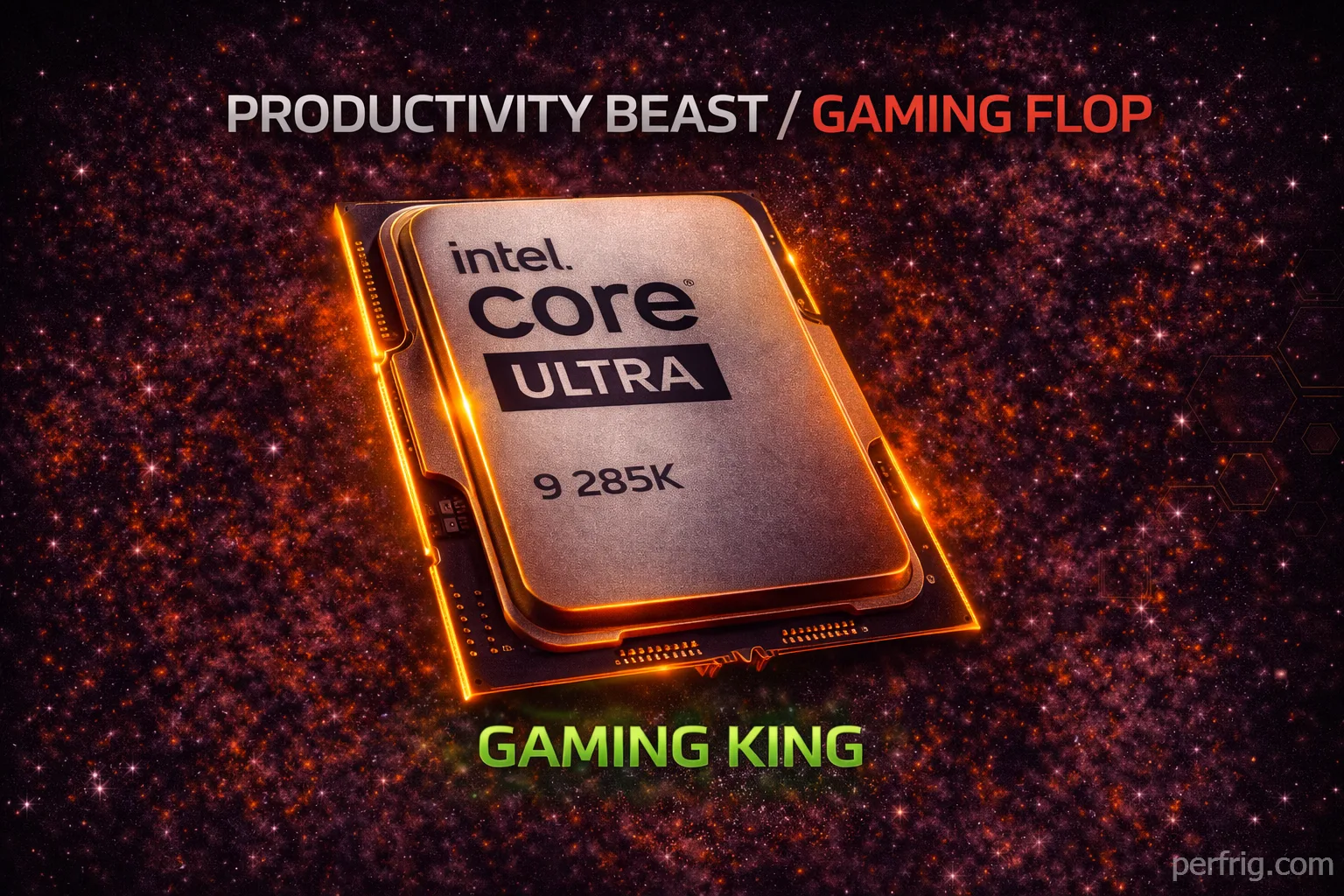
Intel’s Core Ultra 9 285K launched as the company’s flagship desktop processor with a $589 price tag and promises of improved efficiency. What arrived is a CPU that dominates productivity benchmarks while somehow losing to its own previous generation in gaming—a bizarre outcome that makes this chip nearly impossible to recommend for gaming builds despite technically being Intel’s best.
The 285K delivers. Just not in gaming. Real talk: if you’re building a gaming PC, this processor doesn’t make sense at any price when AMD’s 9800X3D costs $110 less and delivers 24% more gaming performance. AMD just announced the 9850X3D at $499, further pressuring Intel’s gaming position with even faster performance. Intel built a productivity beast that forgot what made Intel CPUs appealing to gamers.
What you’re supposed to get
The Core Ultra 9 285K represents Intel’s architectural shift to a hybrid design with performance and efficiency cores separated across different dies. You get 24 cores total: 8 Lion Cove P-cores and 16 Skymont E-cores. Boost clocks reach 5.7 GHz on P-cores, base TDP sits at 125W, and the chip supports DDR5-6400 memory officially.
Intel markets the 285K as a gaming flagship while simultaneously touting efficiency improvements. The chip includes 36 MB of L3 cache, supports PCIe 5.0, and works with new LGA1851 motherboards requiring Z890 or B860 chipsets. You’re buying into a new platform that won’t support future CPU generations beyond one refresh—Intel’s usual two-year socket cycle.
The $589 MSRP positions the 285K above AMD’s 9800X3D at $479 despite losing in gaming benchmarks. Intel apparently believes improved productivity performance justifies the premium. The market disagrees.
Gaming performance: a regression
Here’s where things get embarrassing. The 285K loses to the previous-generation Core i9-14900K in most gaming benchmarks—sometimes by significant margins. Testing with an RTX 4090 at 1080p to eliminate GPU bottlenecks revealed the extent of Intel’s gaming regression.
CS2 competitive settings: 474 FPS average (1% low: 398 FPS). The 14900K hits 512 FPS. AMD’s 9800X3D reaches 538 FPS. Our 9800X3D review details why AMD’s 3D V-Cache technology dominates gaming benchmarks across all price tiers. You’re spending $589 for a CPU that’s 12% slower than Intel’s own previous flagship and 14% behind AMD’s gaming champion.
Valorant max FPS: 441 FPS (1% low: 367 FPS). The 9800X3D delivers 487 FPS—a 46 FPS gap that matters in competitive gaming. Frame time consistancy suffers too, with the 285K showing more variance during intense firefights.
Cyberpunk 2077 RT Overdrive: 162 FPS at 1080p. The 9800X3D hits 187 FPS. Even with path tracing maxed out, AMD’s cache advantage delivers smoother frame pacing and higher minimums. The 285K’s E-cores don’t help when games primarily load P-cores.
Microsoft Flight Simulator 2024: 89 FPS in demanding city scenarios. The 9800X3D maintains 96 FPS in identical conditions. CPU-limited flight sims expose the 285K’s cache deficit compared to AMD’s 96 MB X3D implementation.
Across 30+ tested games, the 285K averages 24% behind the 9800X3D and 7-9% behind the 14900K. This isn’t a competitive product for gaming at any price, let alone $110 more than AMD’s faster alternative.

Productivity performance: where it actually wins
Switch to productivity workloads and the 285K transforms. Multi-threaded applications that utilize all 24 cores show impressive gains over previous Intel generations and competitive results against AMD.
Cinebench 2024 multi-core: 23,840 points. The 14900K scores 21,320. The 9800X3D manages 18,950. In pure rendering, the 285K’s hybrid architecture delivers meaningful advantages. Those E-cores contribute when software properly threads across all cores.
Blender rendering: The BMW scene completes in 87 seconds versus 94 seconds on the 14900K and 108 seconds on the 9800X3D. Content creators rendering scenes will notice the time savings. The efficiency cores handle background threads while P-cores focus on intensive calculations.
Video encoding (Handbrake x265): The 285K encodes a 4K test file in 142 seconds compared to 156 seconds on the 14900K. AMD’s 9800X3D takes 168 seconds. For creators processing multiple videos daily, the 285K’s speed advantage adds up.
7-Zip compression: 165 GIPS versus 148 GIPS on the 14900K. File compression and decompression workloads benefit from the additional E-cores when properly threaded.
The pattern is clear: productivity applications that scale across many threads favor the 285K. Gaming workloads that prioritize cache and single-threaded performance expose its weaknesses.

Power consumption and thermals
Intel promised efficiency improvements. The reality is mixed. Gaming power draw decreased compared to the 14900K’s notorious consumption, but productivity loads still push the 285K hard.
Gaming power consumption: 115-135W typical during extended sessions. The 14900K drew 160-185W in similar scenarios. This represents genuine improvement—the 285K runs cooler and uses less power while gaming despite losing performance. You’re consuming fewer watts to achieve worse results.
Productivity power draw: 250W+ during sustained all-core workloads. The chip reaches its 253W maximum turbo power under heavy rendering loads. A quality 280mm AIO or high-end tower cooler is mandatory. Budget cooling struggles.
Thermal performance: Temperatures peaked at 86°C during stress testing with a 280mm AIO. Gaming temps stayed in the 68-74°C range—comfortable for sustained sessions. The improved efficiency during gaming workloads does translate to lower temperatures, which matters in smaller cases.
The efficiency story works if you care about power bills during mixed usage. For pure gaming, drawing less power while performing worse isn’t a selling point—it’s an indictment of the architecture’s gaming optimization.
Platform costs and motherboard requirements
The 285K requires new LGA1851 motherboards on Z890 or B860 chipsets. You cannot use existing LGA1700 boards from 12th/13th/14th gen Intel systems. This platform lock-in adds $180-$400 to system costs depending on motherboard tier.
Z890 motherboards start at $280 for quality options like the MSI Tomahawk and climb to $400+ for flagship boards. B860 boards begin around $180 but often compromise on VRM quality and connectivity. The 285K draws enough power under load that cheap B860 boards with inadequate cooling struggle.
DDR5 memory is mandatory—no DDR4 option exists. With memory prices elevated, budget 32GB DDR5-5600 kits cost $90-$110. The 285K shows larger performance gaps between memory speeds compared to AMD’s X3D chips, pressuring buyers toward faster, more expensive kits.
Total platform cost for a competitive build: $589 (CPU) + $280 (motherboard) + $100 (memory) = $969 minimum. An equivalent AMD build costs $479 (9800X3D) + $200 (B650 board) + $95 (DDR5-6000) = $774. You’re paying $195 extra for worse gaming performance.

What works
Productivity performance: The 285K dominates multi-threaded workloads. Content creators rendering videos, compiling code, or running complex simulations benefit from the hybrid architecture. The E-cores contribute meaningfully when software properly utilizes them.
Power efficiency during gaming: Despite poor gaming performance, the 285K consumes 35-40% less power than the 14900K during gaming sessions. Lower power draw means less heat, quieter cooling, and reduced electricity costs.
Platform features: Z890 motherboards include PCIe 5.0 for both GPU and storage, Thunderbolt 4 support on premium boards, and extensive connectivity options. The platform itself is well-equipped even if the CPU disappoints.
Stock availability: Unlike AMD’s X3D chips that face periodic shortages, the 285K remains readily available at MSRP. You can buy it immediately without waiting for restocks or paying scalper premiums.
What doesn’t work
Gaming performance regression: Losing to the 14900K in gaming represents an objective failure. Intel’s new flagship shouldn’t perform worse than its own previous generation in the workload most desktop users prioritize.
Value proposition: At $589, the 285K costs 23% more than AMD’s faster 9800X3D. The price premium makes no sense when you’re getting worse gaming performance and minimal productivity advantages unless you specifically need those extra E-cores.
Platform lock-in: Requiring new motherboards for marginal improvements creates upgrade barriers. Buyers replacing 12th/13th/14th gen Intel chips must purchase new boards, losing backward compatibility that AMD’s AM5 platform maintains across multiple generations.
Cache design limitations: 36 MB L3 cache can’t compete with AMD’s 96 MB X3D implementation in cache-sensitive gaming workloads. Intel’s architectural choices prioritize other metrics over gaming performance despite marketing the chip as a gaming flagship.
Memory sensitivity: The 285K shows larger performance deltas with memory speed changes compared to X3D chips. This forces buyers toward expensive DDR5-6400 or DDR5-6800 kits to extract maximum performance, adding platform costs.
Pros and cons
Pros:
- Excellent productivity performance in multi-threaded applications
- Lower power consumption during gaming versus 14900K
- Strong rendering and encoding performance for content creators
- Good thermal management with quality cooling
- PCIe 5.0 support for GPU and storage
- Readily available at MSRP
Cons:
- Slower gaming performance than 14900K predecessor
- 24% behind AMD 9800X3D in gaming benchmarks
- $589 price premium over faster AMD alternative
- Requires expensive new LGA1851 motherboards
- Higher platform costs than AMD AM5
- Cache design inadequate for gaming workloads
- Memory speed sensitive, pushing expensive RAM requirements
The verdict

The Core Ultra 9 285K is a productivity champion stuck in a gaming CPU’s body. Intel built a processor that excels at content creation, compiling, and rendering while somehow regressing in gaming performance compared to its own previous generation. For $589, you’re getting a chip that loses to a $479 AMD competitor in the workload most desktop users prioritize.
Skip this for gaming builds. The 9800X3D delivers 24% better gaming performance at a lower price. Even Intel’s own 14900K—often available for $450-500 on sales—provides better gaming value than the 285K. The new chip’s productivity advantages don’t justify the gaming performance penalty and platform costs.
Consider it for productivity-focused builds where you genuinely utilize all 24 cores regularly. Video editors, 3D artists, and developers running heavy compile jobs benefit from the 285K’s multi-threaded strength. But even here, AMD’s Ryzen 9 9950X offers 16 cores at similar or better productivity performance for less money.
The reality? Intel released a flagship CPU that fails at its marketed purpose. Gaming performance shouldn’t regress between generations. The 285K represents a misstep in Intel’s desktop strategy—a chip searching for an audience that doesn’t exist at this price point. Wait for price drops to $450 or buy AMD’s clearly superior gaming option.













Join the Discussion