
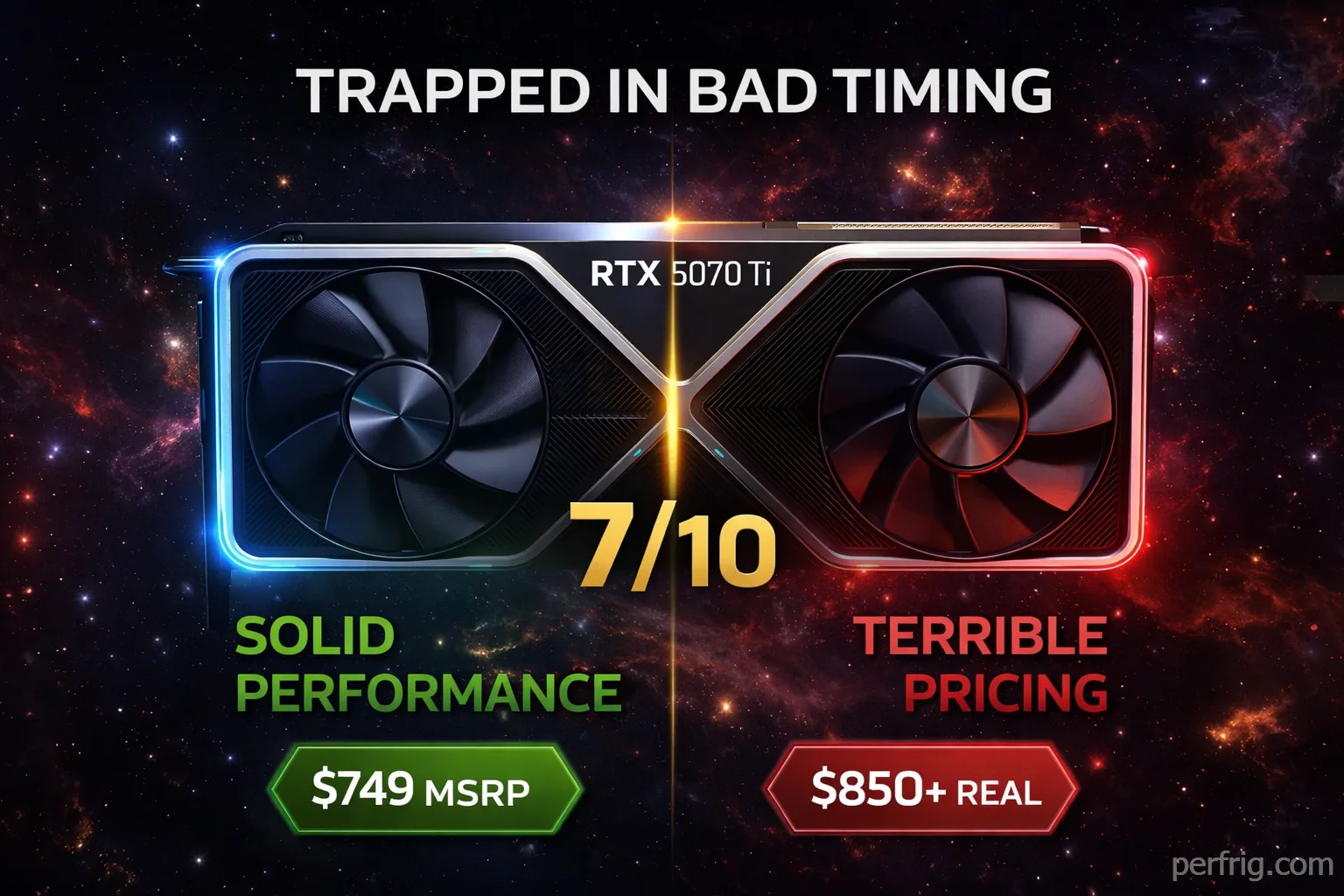
The RTX 5070 Ti launched on January 30, 2026 at $749 MSRP, Our launch coverage detailed the RTX 5070 Ti’s specifications and availability issues that continue plaguing buyers. Positioning itself as NVIDIA’s mid-range flagship. Real talk? This card delivers RTX 4080-level performance for $250 less—which sounds great until you realize the 4080 launched two years ago. NVIDIA’s asking you to pay $749 for last generation’s performance with a new sticker. The 5070 Ti performs roughly identical to the RTX 4080 Super in most games, making it a 13% upgrade over the 4070 Ti Super it replaces. That’s generational stagnation dressed up with DLSS 4 marketing.
After testing the ASUS Prime RTX 5070 Ti across 17 games at 1080p, 1440p, and 4K, the verdict is clear: this GPU delivers strong 1440p performance but terrible value in 2026’s broken GPU market. If you secured one at $749 MSRP, you got a decent card. At the $850-950 street prices actually available? Skip it entirely.
Gaming performance: 4080-tier with asterisks
The RTX 5070 Ti targets 1440p gaming according to NVIDIA, and testing confirms this sweet spot. At 1440p ultra settings, the card averaged 163 FPS across demanding titles, with every tested game exceeding 120 FPS and eight titles surpassing 240 FPS. That’s legitimatly strong performance for high refresh rate gaming at 1440p.
Marvel Rivals ran at 187 FPS average at 1440p—matching the RTX 4080 Super and landing 12% behind the RTX 5080. The card proved 14% faster than AMD’s RX 7900 XT and 17% faster than the 4070 Ti Super it replaces. Move to 4K and performance remains 12% behind the 5080 while delivering roughly 20% gains over both the 4070 Ti Super and 7900 XT.
Cyberpunk 2077 tells a different story. At 1440p, the 5070 Ti managed just 9% improvement over the 4070 Ti Super—barely noticeable in actual gameplay. The 4K results improved to 18% faster than the 4070 Ti Super, though this remains underwhelming for a generational jump.
Final Fantasy XIV at 4K produced 97 FPS average with 1% lows at 80 FPS—identical to the RTX 4080. Here’s where the generational stagnation becomes obvious: you’re buying 2024’s flagship performance in 2026 for slightly less money. That’s not progress, that’s pricing manipulation.
The 5070 Ti consistently delivered between 9-25% improvements over the 4070 Ti Super depending on the game, with ray tracing workloads showing stronger gains. Against AMD’s RX 7900 XTX, the cards trade blows in rasterization with the 5070 Ti pulling ahead in ray traced titles. The 5080 maintains a 12-17% performance lead across resolutions—not enough to justify its $250 higher price tag.
Ray tracing: NVIDIA’s advantage remains
Ray tracing performance shows the 5070 Ti’s strengths. The fourth-generation RT cores deliver meaningful gains over previous generation cards, with performance matching or exceeding the RTX 4080 in demanding titles like Alan Wake 2 and Cyberpunk 2077 with path tracing enabled.
Against AMD’s flagship RX 7900 XTX, the gap widens dramatically in ray traced workloads. NVIDIA’s superior RT hardware and better driver optimization in games like Minecraft RTX and F1 24 create performance differences exceeding 30% in favor of the 5070 Ti. If ray tracing matters for your gaming, AMD simply isn’t competitive at this price point.
The caveat? Ray tracing tanks frame rates significantly even on the 5070 Ti. Stalker 2 with full ray tracing dropped to 47 FPS average at 1440p—playable but far from smooth. DLSS upscaling becomes mandatory for maintaining high frame rates in demanding RT titles, which brings us to NVIDIA’s real differentiator.
DLSS 4: the real selling point
DLSS 4 with Multi Frame Generation represents NVIDIA’s primary advantage over AMD. In Final Fantasy XIV at 4K, native performance sat at 58 FPS. Enable DLSS with MFG x2 and frame rates jumped to 172 FPS. Crank MFG to x4 mode and you’re looking at 280 FPS—nearly 5X the native performance.
The problem? Only 15 games currently support DLSS 4 at launch. You’re betting on future game support to justify the purchase. The technology introduces 20-30ms of additional latency, making it unsuitable for competitive multiplayer titles where responsiveness matters more than frame counts.
DLSS 4 works brilliantly in single-player games like Cyberpunk 2077 and Black Myth: Wukong, dramatically improving frame pacing and enabling smoother gameplay. For competitive FPS titles, you’ll disable it immediately and rely on the card’s native performance—which is just RTX 4080 level.
Power consumption and thermals
The 5070 Ti draws approximately 264W under gaming loads—reasonable for its performance class. NVIDIA recommends an 850W PSU, though quality 750W units work fine with mid-range CPUs.
The ASUS Prime model peaked at 65°C under sustained loads, running virtually silent. Most partner models deliver excellent thermals given the reasonable power draw. Efficiency represents one genuine win for the 5070 Ti.
The pricing disaster
NVIDIA set $749 MSRP knowing buyers won’t see that price. Real availability shows $850-950 for partner models, some reaching $1,000+. At $850, you’re paying 13% more for 13% better performance than the 4070 Ti Super—inflation disguised as progress.
The 5080 costs $999 MSRP ($1,183-1,300 actual) for 15% better performance. That’s 33% higher price for 15% gains—terrible value making the 5070 Ti look reasonable by comparison.
Used RTX 4080 cards sell for $700-800, delivering identical performance while lacking only DLSS 4. Unless you desperately need frame generation, buying used makes more sense.
The February RTX 5070 launch at $599 MSRP looms over every decision. That’s $150 less for 10-15% lower performance—potentially far better value.
Availability and competition
Launch availability proved disastrous. Retailers sold out within minutes, restocks limited to AIB models $100-200 above MSRP. Supply likely stabilizes by March 2026—6-8 weeks away.
AMD’s absence amplifies NVIDIA’s pricing power. RX 9070 XT delayed until Q2 2026 leaves no competition at $600-800. The RX 7900 XTX offers comparable rasterization but falls behind in ray tracing and lacks DLSS.
Final verdict: 7/10 – CONSIDER (only at MSRP)
The RTX 5070 Ti delivers solid 1440p gaming performance and strong ray tracing capabilities. It matches the RTX 4080 in most scenarios while costing $250 less at MSRP. DLSS 4 provides genuine benefits in supported titles. The efficiency and thermals impress.
Bottom line? This card only makes sense at the $749 MSRP you probably can’t find. At $850+ street pricing, you’re overpaying for last generation’s flagship performance with minimal improvements. The RTX 5080 offers poor value at $999+, making the 5070 Ti look reasonable by comparison—but that’s NVIDIA’s strategy, not actual value.
BUY IF: You secured $749 MSRP pricing, prioritize ray tracing and DLSS 4, need 16GB VRAM for 1440p gaming.
SKIP IF: Cards sell above $800, you can wait for March supply or RTX 5070 launch, you’re upgrading from RTX 4080/4080 Super.
CONSIDER IF: Your current GPU struggles at 1440p, AMD doesn’t interest you, you’re upgrading from RTX 3070 or older.
The reality? Most buyers should wait. March brings better availability and the RTX 5070 potentially offering superior value. If you can’t wait and find $749 pricing, the 5070 Ti delivers. At inflated prices, skip entirely and buy used or wait for competition.
Pros:
- Strong 1440p performance (120+ FPS in all tested games)
- Matches RTX 4080 for $250 less (at MSRP)
- Excellent ray tracing performance vs AMD
- DLSS 4 dramatically boosts frame rates in supported titles
- 16GB VRAM future-proofs at 1440p
- Reasonable power consumption (264W)
- Quiet operation and good thermals
Cons:
- Generational stagnation (just 4080 performance repackaged)
- 13% improvement over 4070 Ti Super inadequate
- $850+ street pricing destroys value proposition
- Terrible launch availability
- Only 15 games support DLSS 4 currently
- RTX 5070 ($599) launches in February
- Used RTX 4080 offers similar performance cheaper








Join the Discussion