
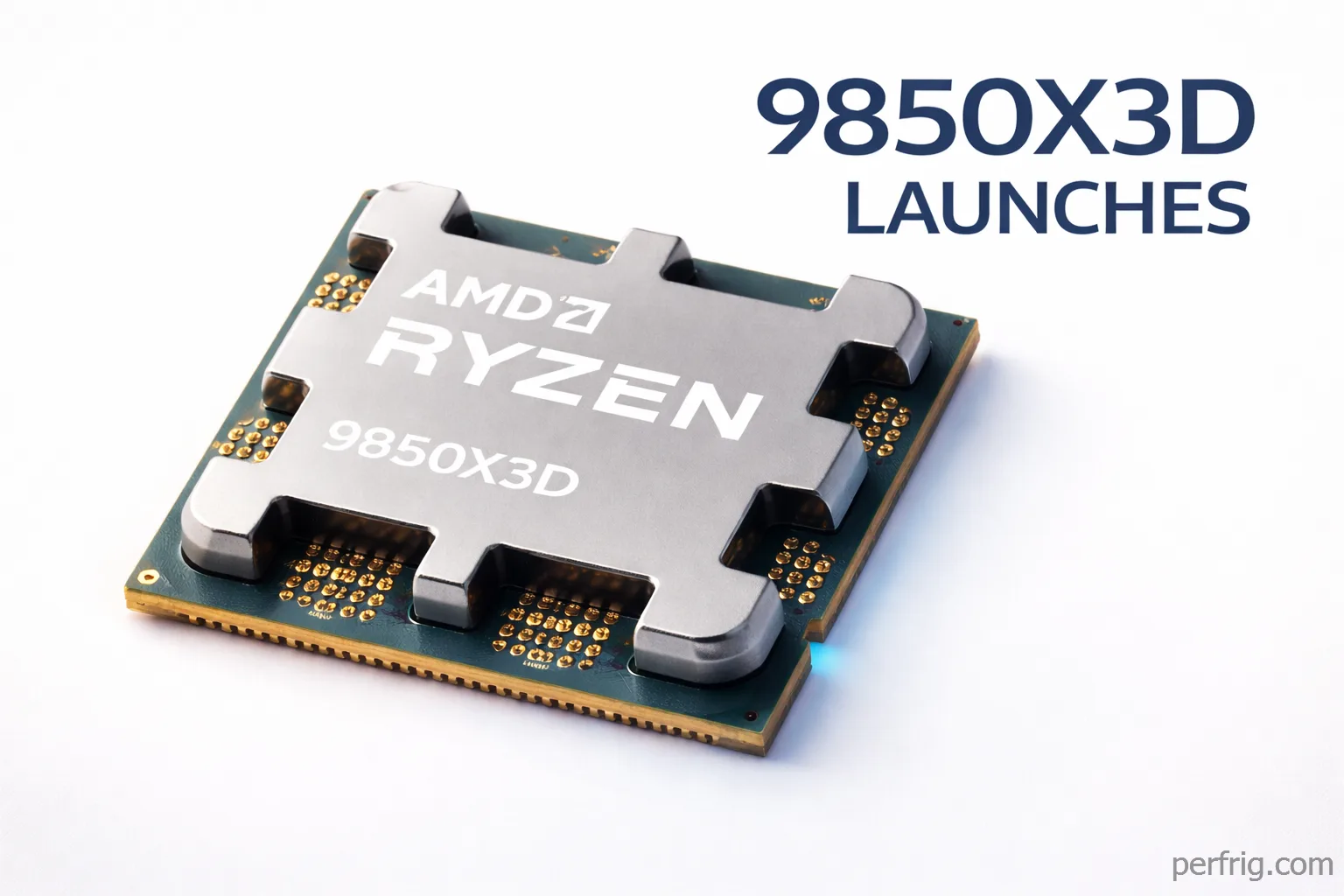

AMD Ryzen 7 9850X3D announcement: gaming’s new flagship launches January 29
CONTENTS
AMD confirmed pricing and availability for the Ryzen 7 9850X3D on January 22, 2026, positioning its latest X3D processor as the world’s fastest gaming CPU. The chip launches January 29 at $499 MSRP—a $20 premium over the 9800X3D’s $479 launch price—and promises measurable gaming performance gains through clock speed improvements rather than architectural changes.
The 9850X3D maintains eight Zen 5 cores and 16 threads while boosting clock speeds to 5.6 GHz—400 MHz higher than the 9800X3D. This represents AMD’s strategy of incremental refinement: squeezing additional performance from proven silicon rather than introducing new technology. For gamers seeking maximum frame rates, the question becomes whether 400 MHz justifies a $20 price increase when the 9800X3D remains widely available.
What AMD announced
AMD’s January 22 announcement clarified details that CES 2026 attendees anticipated but didn’t receive. The chip launches January 29 at major retailers including Newegg and Micro Center, ending weeks of speculation following the processor’s accidental appearance in AMD driver listings earlier this month.
The 9850X3D’s specifications mirror its predecessor across most metrics. Base frequency stays at 4.7 GHz, L3 cache holds at 96 MB powered by second-generation 3D V-Cache technology, and TDP remains 120W. The meaningful change is that 5.6 GHz boost clock—the highest in AMD’s X3D lineup and a direct response to Intel’s Core Ultra 9 285K.
AMD claims the 9850X3D delivers up to 27% faster gaming performance than Intel’s Core Ultra 9 285K, based on aggregate testing across 30+ titles. That performance lead exists partly because Intel’s latest flagship underperforms in gaming compared to its own previous generation. The Core Ultra 9 285K trails the Core i9-14900K in gaming benchmarks, positioning AMD’s X3D chips in a comfortable leadership position.
The $499 price point places the 9850X3D between mainstream and flagship territory. It undercuts the Ryzen 9 9950X3D’s $699 price by $200 while offering most of what gamers actually need—strong single-threaded performance, massive cache for gaming workloads, and compatability with existing AM5 motherboards. The pricing acknowledges market realities: with RAM and storage costs elevated, CPU pricing remains one area where buyers can find predictability.
Performance claims and memory requirements
AMD’s performance messaging focuses on two areas: gaming superiority over Intel and reduced reliance on expensive memory. Across 30+ games, the FPS difference between DDR5-4800 and DDR5-6000 was less than 1%, according to AMD’s testing. This positions the 9850X3D as appealing during a period when DDR5 pricing remains elevated.
The claim matters because memory costs currently pressure system budgets more than CPU pricing. A builder spending $499 on a 9850X3D can pair it with less expensive DDR5-5200 or DDR5-5600 memory without sacrificing gaming performance. This contrasts with Intel’s Core Ultra 9 285K, which shows larger performance deltas with faster memory configurations.
Gaming performance leads vary significantly by title. AMD’s benchmarks show improvements ranging from 5% in Call of Duty: Black Ops 7 to 60% in Baldur’s Gate 3 versus the Core Ultra 9 285K. The wide range reflects different game engines and their sensitivity to cache size versus clock speed. Titles with large open worlds and complex AI—Baldur’s Gate 3, Cyberpunk 2077, Starfield—benefit most from X3D’s massive cache.
The 27% average gaming lead over Intel represents the aggregate across these varied results. Independent reviews will verify whether AMD’s test conditions reflect real-world scenarios. What matters for buyers is that the 9850X3D maintains AMD’s gaming performance crown regardless of whether the lead is 20% or 30%.
Positioning against the 9800X3D
AMD’s challenge is differentiating the 9850X3D from its still-popular predecessor. The 9800X3D remains widely available at $469 and delivers excellent gaming performance. Our 9800X3D review showed it dominating gaming benchmarks, making the 9850X3D’s modest improvement a tough sell for existing owners. For a $30 difference, buyers must decide whether 400 MHz boost clock improvement justifies the premium.
Some observers characterize the 9850X3D as a binned version of the 9800X3D—silicon that achieved higher stable frequencies during manufacturing. If accurate, this means the 9850X3D isn’t fundamentally different hardware but rather silicon that passed stricter quality standards. For builders, this distinction matters little if performance gains materialize.
AMD likely positioned the 9850X3D for buyers who don’t already own a 9800X3D rather than attempting to convince 9800X3D owners to upgrade. The 3% theoretical performance difference—based on clock speed alone—doesn’t justify replacement for existing users. Instead, the 9850X3D targets gamers upgrading from Ryzen 5000 or 7000 series processors, or builders switching from Intel platforms.
The naming similarity between 9800X3D and 9850X3D creates potential confusion. Buyers comparing specifications must look closely at boost clocks to understand the difference. AMD’s marketing emphasizes “world’s fastest gaming processor” messaging rather than highlighting the modest generational improvement.
Platform compatibility and market timing
The 9850X3D uses the AM5 socket and is compatible with current 600 and 700 series motherboards, maintaining AMD’s commitment to extended platform support. Builders with existing AM5 systems can upgrade without replacing motherboards, RAM, or coolers—a significant advantage over Intel’s more frequent socket changes.
This compatibility extends AM5’s value proposition. A buyer who purchased a B650 motherboard for a Ryzen 7600 in 2023 can now upgrade to the fastest gaming processor available without additional platform costs. This upgrade path strengthens AMD’s position among enthusiasts planning multi-year builds.
The 120W TDP allows use with standard desktop coolers without requiring high-end cooling solutions. Quality tower coolers or 240mm AIO liquid coolers handle the 9850X3D’s thermal output comfortably. This differs from Intel’s Core Ultra 9 285K, which draws higher power under sustained loads and requires more robust cooling.
Timing matters for the 9850X3D’s market reception. Launching in late January positions it ahead of potential Intel responses while memory and storage pricing remain elevated. Buyers building systems now face difficult budget allocation decisions. A CPU that delivers maximum gaming performance without requiring expensive high-frequency RAM addresses real market needs.
What this means for gaming builds
The 9850X3D’s arrival solidifies AMD’s gaming dominance heading into 2026. Intel’s Core Ultra 9 285K trails in gaming benchmarks despite costing more, leaving Intel without a competitive answer in the enthusiast gaming segment. Until Intel launches Nova Lake or Panther Lake derivatives specifically optimized for gaming, AMD faces minimal pressure.
For buyers, the 9850X3D represents clear value if building from scratch or upgrading from older platforms. The $499 price point delivers flagship gaming performance without the $700 cost of the 16-core 9950X3D. Paired with mid-range DDR5-5200 memory and a quality B650 or X870 motherboard, the 9850X3D anchors a balanced gaming system.
Current 9800X3D owners have little reason to upgrade. The performance difference is too small to justify spending $499 for marginal gains. The 9850X3D makes sense for builders who delayed purchasing a 9800X3D due to stock shortages or who want the highest clock speeds available in AMD’s X3D lineup.
The memory insensitivity claim—if validated by independent testing—removes one traditional constraint from high-end gaming builds. Builders can allocate saved memory budget toward better GPUs, larger SSDs, or premium cooling solutions. This shifts optimization strategies compared to previous generations where memory speed significantly affected frame rates.
Market context and future outlook
AMD’s X3D lineup faces minimal competition as 2026 begins. Intel’s gaming performance regression with Core Ultra 200 series created an opening AMD exploited effectively. The 9850X3D capitalizes on this advantage while memory and storage shortages make CPU pricing stability particularly valuable.
The processor’s launch timing avoids direct conflict with rumored Intel Core Ultra 200K Plus processors potentially arriving in spring 2026. These chips reportedly target gaming performance improvements, but specifications remain unconfirmed. AMD secures Q1 2026 sales before Intel can respond.
Looking ahead, AMD’s Zen 6 architecture on TSMC’s 2nm process will eventually replace the 9850X3D. That transition likely occurs late 2026 or early 2027, giving the 9850X3D a reasonable market lifespan. Buyers purchasing now won’t face immediate obsolescence.
The 9850X3D represents AMD’s refinement strategy: incremental improvements maintaining performance leadership without requiring new platform investments. This approach benefits AMD’s margins while delivering measurable gains for buyers. Whether 400 MHz justifies a $20 premium depends on individual budgets and upgrade paths, but the 9850X3D solidifies AMD’s position as the gaming CPU leader heading into 2026.

