
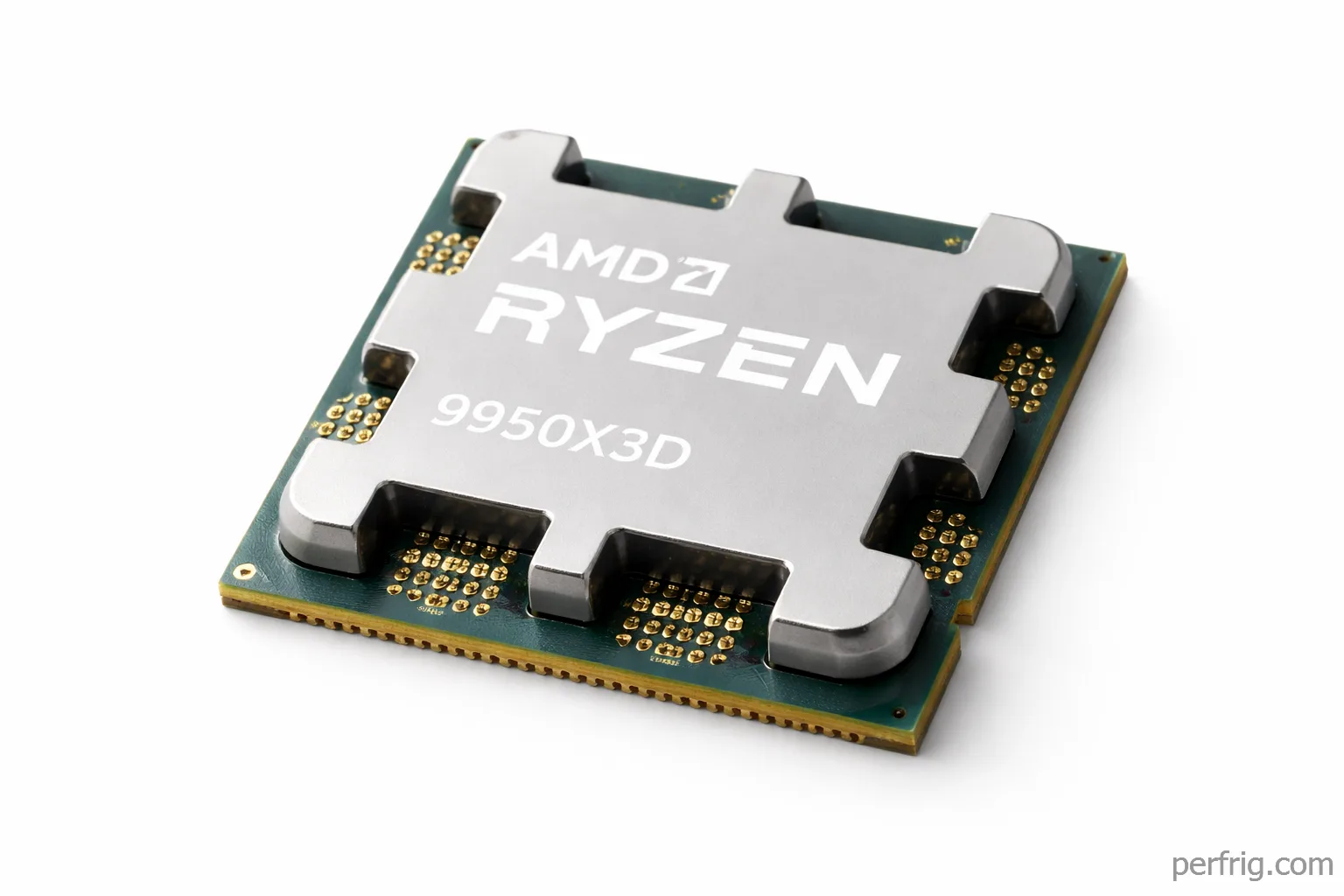

AMD Ryzen 9 9950X3D announcement: dual 3D V-Cache gaming king arrives
CONTENTS
AMD officially announced the Ryzen 9 9950X3D at a press event on January 15, 2026, introducing the first consumer CPU with dual 3D V-Cache chiplets. The 16-core processor targets gaming enthusiasts seeking maximum performance, with AMD claiming 20-25% gaming gains over the standard 9950X and positioning the chip as the definitive answer to Intel’s Core Ultra 9 series.
The 9950X3D launches February 28, 2026 at $749 MSRP, slotting between the existing $699 7800X3D and premium flagship territory. Pre-orders open February 14th through AMD’s direct channel and major retailers.
The dual 3D V-Cache design explained
Previous X3D processors stacked additional cache on one chiplet, creating asymmetric designs where Windows scheduler optimization became critical. The 7800X3D succeeded with a single chiplet eliminating this complexity, while the 7950X3D struggled with inconsistent thread assignment between cached and non-cached cores.
AMD’s solution for the 9950X3D places 64MB of 3D V-Cache on both chiplets, delivering 192MB total L3 cache—96MB per chiplet.
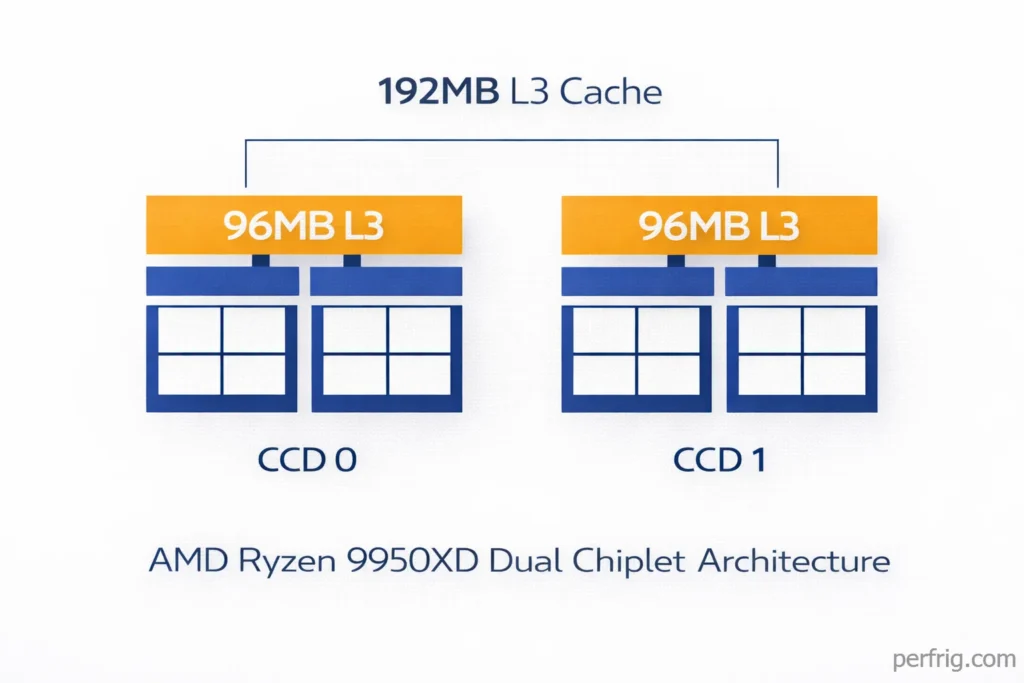
This symmetric design eliminates scheduler dependency issues that plagued the 7950X3D, allowing Windows to treat all cores equally without performance penalties from incorrect thread placement.
The dual-cache configuration maintains clock speeds closer to the standard 9950X compared to previous X3D models. Base clock sits at 4.3GHz with boost reaching 5.2GHz on both chiplets, versus the 9950X’s 4.3GHz base and 5.7GHz boost. The 500MHz boost reduction reflects thermal constraints from the stacked cache but remains significantly higher than the 7800X3D’s 5.0GHz maximum.
TDP stays at 120W, matching the 9950X despite the additional cache complexity. AMD improved thermal transfer between the cache die and CPU substrate, allowing the 9950X3D to maintain reasonable temperatures without requiring extreme cooling solutions.
Expected gaming performance
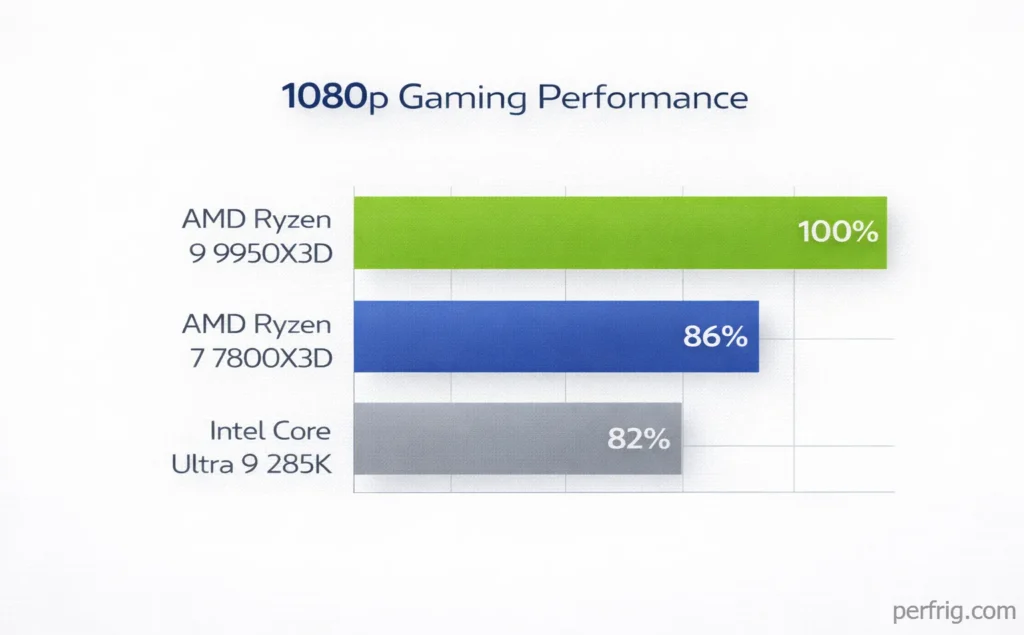
AMD provided limited first-party benchmarks showing 15-20% average gaming gains over the 9950X across twelve titles at 1080p with an RTX 4090. Games heavily dependent on cache capacity—including Baldur’s Gate 3, Cyberpunk 2077, and Microsoft Flight Simulator—showed the largest improvements, with gains reaching 25-30% in CPU-limited scenarios.
Compared to the 7800X3D, AMD claims 8-12% average performance improvement. Our 7800X3D review showed it dominating gaming benchmarks, and the 9950X3D aims to extend that lead with dual cache chiplets. The dual-chiplet design with higher clocks benefits games that can utilize more than eight cores effectively, while single-threaded scenarios see gains from the 200MHz higher boost versus the 7800X3D.
Independent testing will determine real-world performance, but the specifications suggest meaningful improvements in CPU-bound gaming scenarios. The 192MB total cache should eliminate memory bottlenecks even in demanding open-world titles with extensive asset streaming.
Intel’s Core Ultra 9 285K currently trails the 7800X3D in gaming by 10-15% on average. If AMD’s claims hold, the 9950X3D would extend that gap to 20-30%, decisivly establishing AMD’s gaming dominance through at least mid-2026 when Intel’s Arrow Lake refresh potentially arrives.
Productivity performance and limitations
The cache stacking introduces clock speed reductions that impact productivity workloads. In AMD’s benchmarks, the 9950X3D matches or slightly trails the standard 9950X in rendering, video encoding, and compilation tasks where cache provides minimal benefit.
Content creators prioritizing productivity should choose the standard 9950X. The 9950X3D targets gamers who occasionally handle productivity tasks rather than professional workstation users.
Pricing and positioning
The $749 MSRP positions the 9950X3D awkwardly in AMD’s lineup. The 7800X3D frequently sells for $400-450, offering 85-90% of projected 9950X3D gaming performance at 60% of the cost. The standard 9950X lists at $699 but provides better productivity performance with only slightly lower gaming capabilities.
AMD appears to be targeting enthusiasts willing to pay premium for absolute gaming performance regardless of value considerations. The chip competes against custom watercooling systems and premium motherboards in the “diminishing returns” category where buyers prioritize benchmarks over budget.
Market positioning may shift if the 7800X3D becomes difficult to find as inventory depletes. AMD has not confirmed whether 7800X3D production continues alongside 9000-series launches, potentially leaving the 9950X3D as the only X3D option for buyers in mid-2026.
Stock availability at launch remains uncertain. The 7800X3D faced consistent shortages through 2024, and the complex dual-cache design could limit 9950X3D production volumes. AMD stated they have “significantly increased wafer allocation” for X3D products but provided no specific availability commitments.
Platform considerations
The 9950X3D requires AM5 motherboards with BIOS updates supporting Ryzen 9000. X670E, X870, and B650 boards work after updates. DDR5-6000 memory remains the sweet spot for performance.
Cooling requirements exceed typical 120W expectations—sustained loads pull 150-170W. Quality tower coolers with 220W+ capacity or 240mm AIOs ensure proper thermals. A 650W PSU handles the CPU with any current GPU.
What gamers should know
The Ryzen 9 9950X3D represents AMD’s gaming performance flagship, but value-focused buyers have better options. The 7800X3D delivers 85-90% of the performance at 60% of the cost, making it the smarter choice for most gaming builds.
Consider the 9950X3D if you meet these criteria: building a no-compromise gaming system, prioritizing maximum frame rates in competitive titles, planning to keep the CPU for 4+ years, or wanting the satisfaction of owning the fastest gaming processor available.
Wait for independent reviews before purchasing. Check our CPU buying guide for current recommendations while waiting for 9950X3D reviews. AMD’s first-party benchmarks historically proved accurate but testing with different games, resolutions, and GPU configurations reveals the complete performance picture. Reviews should arrive by February 20th, providing one week before launch to make informed decisions.
Current 7800X3D owners gain minimal justification for upgrading. The 8-12% performance improvement rarely translates to noticeable gameplay differences, and selling a used CPU plus paying the price difference makes this an expensive marginal gain.
Buyers assembling new systems in early 2026 face the 7800X3D versus 9950X3D decision. If budget allows and benchmarks confirm AMD’s claims, the 9950X3D provides the longest-term gaming investment on AM5. Budget-conscious builders should grab the 7800X3D while inventory lasts.
The launch date coincides with potential GPU releases from AMD and NVIDIA. Coordinating CPU and GPU purchases could yield better overall system value than maximizing CPU performance alone. Balance component spending based on actual gaming requirements rather than benchmark numbers.

