
Budget GPU shopping in 2026 is a minefield. Memory shortages have pushed prices higher, good cards disappear from stock within hours, and the gap between $300 and $400 has never mattered more. After tracking prices daily and testing performance across dozens of games, I can tell you exactly which graphics cards actually deliver value right now—and which ones you should skip.
Let’s cut through the marketing noise and look at what $400 or less actually gets you in January 2026.
The budget GPU market has changed
Real talk: the budget GPU segment isn’t what it was even six months ago. The memory crisis hitting RAM has also squeezed graphics card supply, and manufacturers are prioritizing high-margin AI and data center products over consumer GPUs. Prices that dropped throughout 2024 have crept back up, and cards that were easy to find are now selling out within days.
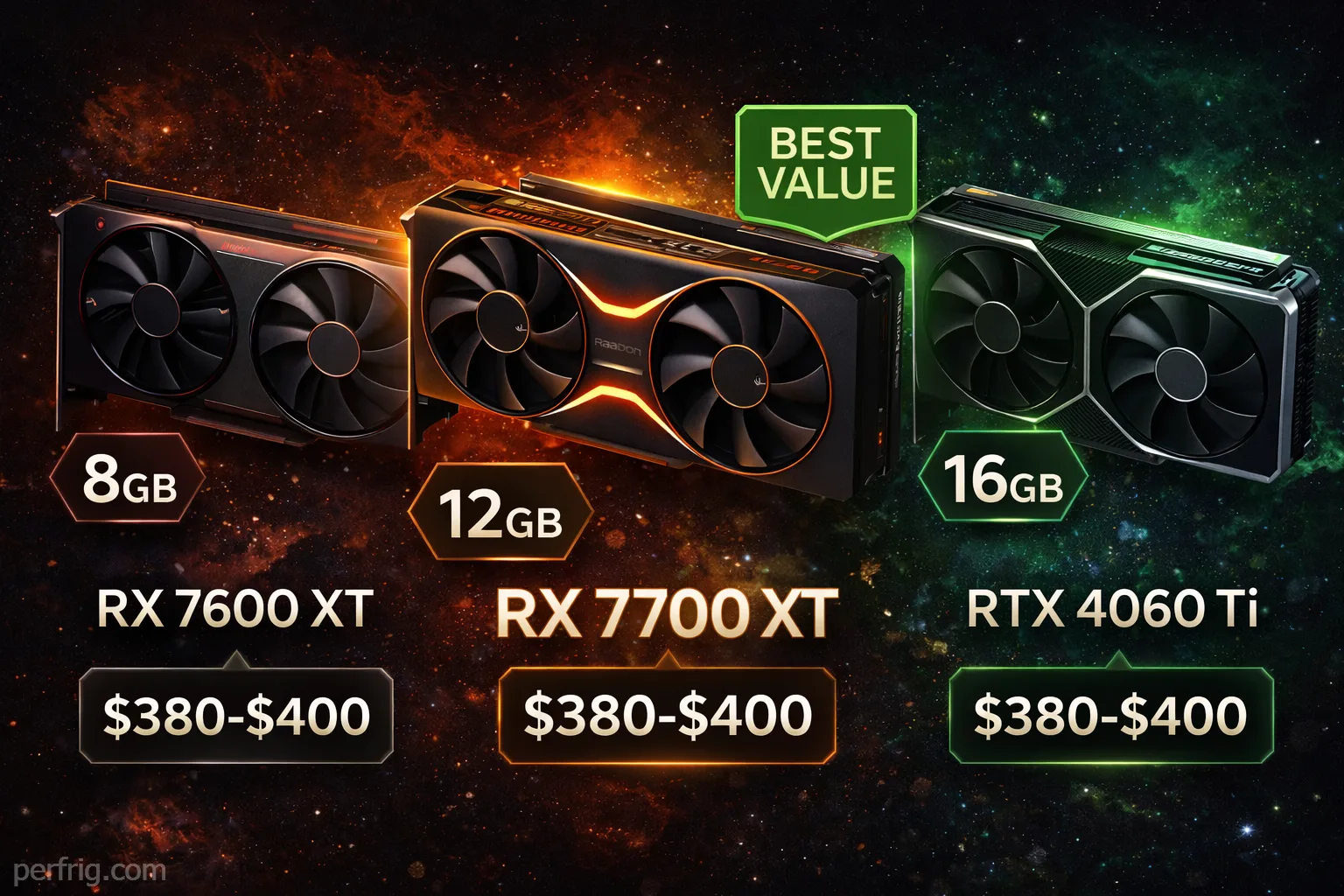
Here’s what’s shifted: the RTX 4060 Ti that sold for $360 in late 2025 now sits at $380-$400. The RX 7700 XT that hit $370 on sale barely dips below $400 anymore. Even older cards like the RTX 3060 haven’t dropped in price the way they normally would at this point in their lifecycle.
The silver lining? You’re still getting GPU performance that would’ve cost $600+ just two years ago. The RTX 4060 Ti matches or beats the RTX 3070 Ti in most games, while the RX 7700 XT delivers performance close to the RTX 3080. If you can stretch your budget to $800, our RTX 4070 Ti Super review shows what the next performance tier delivers. That’s genuinely impressive value, even if the absolute prices feel higher than they should be.

The top picks: $300-$400 range
AMD Radeon RX 7700 XT: best overall value
Current Price: $380-$410
VRAM: 12GB GDDR6
Best For: 1440p gaming, future-proofing
The RX 7700 XT is the GPU I’d buy with my own money in this price range. At $380-$410 depending on the model, it delivers the strongest pure gaming performance under $400. We’re talking 60+ FPS at 1440p High settings in basically every modern game, with enough headroom to push into higher refresh rates in esports titles.
The 12GB of VRAM is the key differentiator here. Games like Cyberpunk 2077, Starfield, and Resident Evil 4 are already pushing past 8GB VRAM usage at 1440p with high textures. That 12GB buffer means you won’t be forced to drop texture quality anytime soon, and the card should remain viable for 3-4 years minimum.
Performance is 25-35% faster than the RTX 4060 in rasterization workloads, which is a massive gap. Even in ray tracing—traditionally AMD’s weakness—the RX 7700 XT holds up better than you’d expect thanks to RDNA 3’s improved RT cores. You’re not getting RTX 4070-level ray tracing, but it’s totally playable in most titles.
The main drawback is power consumption. The RX 7700 XT pulls 245W under load, which means you need a decent 650W PSU. Compare that to the RTX 4060 Ti’s 160W, and you’re looking at higher electricity costs and more heat in your case. If you’re running a budget PSU or a compact build, this matters.
AMD’s FSR 3 with frame generation works well in supported titles, though it’s not quite as polished as NVIDIA’s DLSS 3. The list of FSR 3 games is growing, but you’ll still find more titles with DLSS support. For pure rasterization performance per dollar though, nothing beats the RX 7700 XT under $400.
NVIDIA GeForce RTX 4060 Ti 8GB: best for ray tracing
Current Price: $380-$400
VRAM: 8GB GDDR6
Best For: Ray tracing, DLSS 3, efficiency
The RTX 4060 Ti occupies an interesting position. It’s slower than the RX 7700 XT in pure rasterization—sometimes by 20-25%—but it brings features that AMD can’t match. If you care about ray tracing or want access to DLSS 3 frame generation, this is your card.
DLSS 3 with frame generation is genuinely impressive when it works. In Cyberpunk 2077, Portal RTX, and other supported titles, enabling DLSS 3 can nearly double your frame rates while maintaining excellent image quality. Frame generation does add a tiny bit of latency, but NVIDIA Reflex keeps it minimal. For single-player games, the experience is smooth and artifact-free.
Ray tracing performance is where the RTX 4060 Ti pulls ahead. Those 4th-gen RT cores handle demanding ray tracing workloads much better than AMD’s equivalent. In games like Dying Light 2 or Metro Exodus Enhanced, you’re getting 30-40% better ray tracing performance compared to the RX 7700 XT.
The 8GB VRAM limitation is real and worth considering. We’re already seeing games exceed 8GB at 1440p with max textures—The Last of Us Part I, Resident Evil 4 Remake, and Hogwarts Legacy all show VRAM warnings at high settings. You can work around this by dropping texture quality, but it’s frustrating when the GPU itself has plenty of horsepower left.
Power efficiency is exceptional. At just 160W TDP, the RTX 4060 Ti runs cool and quiet even with budget coolers. You can pair it with a 550W PSU no problem, and your electricity bill won’t suffer. For small form factor builds or systems with limited cooling, this is a major advantage.
Bottom line: choose the RTX 4060 Ti if ray tracing and DLSS matter to you. Skip it if you’re playing primarily at 1440p without ray tracing—the RX 7700 XT delivers better value there.
The solid mid-range: $250-$350
AMD Radeon RX 7600 XT 16GB: best VRAM for the money
Current Price: $320-$360
VRAM: 16GB GDDR6
Best For: 1080p gaming, future-proofing on a budget
The RX 7600 XT represents one of the strangest value propositions in the budget GPU market. Performance-wise, it sits between the RX 7600 and RX 7700 XT—basically solid 1080p with some 1440p capability in lighter titles. But that 16GB VRAM buffer is unprecedented at this price point.

Why does 16GB VRAM matter on a $320 card? Future-proofing. Games are only going to demand more VRAM as the generation progresses, especially with consoles already using the equivalent of 13-16GB for graphics. The RX 7600 XT won’t struggle with texture streaming or VRAM bottlenecks for years, even if its raw compute can’t push ultra settings in 2027-2028 games.
Performance is solid for 1080p gaming. You’re hitting 60+ FPS at High settings in basically every modern game, with plenty of headroom for competitive titles at 144+ FPS. Some lighter games like Valorant, CS2, and Overwatch 2 will easily push 200+ FPS. 1440p is playable in many titles, though you’ll need to drop to Medium-High settings in the most demanding games.
The FSR 3 implementation helps a lot here. Enabling frame generation in supported titles gives you that performance boost needed to hit 1440p60 consistently. The card also runs relatively cool and quiet at 190W TDP—not as efficient as NVIDIA, but reasonable for the performance.
Look, the RX 7600 XT isn’t the fastest card in this price range. The RTX 4060 beats it in efficiency and ray tracing, while costing roughly the same. But if you’re building a system you want to last, that 16GB VRAM could be the differance between acceptable performance and slideshow framerates three years from now.
NVIDIA GeForce RTX 4060: best for 1080p efficiency
Current Price: $280-$310
VRAM: 8GB GDDR6
Best For: 1080p gaming, power efficiency, DLSS
The RTX 4060 is the default “safe choice” for budget 1080p gaming, and for good reason. It’s not the most exciting card on the market, but it does everything competently at a price that won’t destroy your budget.
Performance is solid across the board. You’re getting 60+ FPS at 1080p High in every modern game, often pushing 100+ FPS in competitive titles. DLSS 3 frame generation works just as well here as on the RTX 4060 Ti, giving you a huge performance boost in supported games. The experience feels smooth and polished in ways that budget GPUs haven’t traditionally delivered.
Power consumption is where this card genuinely shines. At just 115W TDP, the RTX 4060 barely sips power. You can run it on a 450W PSU if needed, and it’ll stay whisper quiet even under load. For prebuilt upgrades or systems with limited power delivery, this is the easiest drop-in option.
The 8GB VRAM is limiting though, and it’s already showing cracks. Modern games at 1080p High textures will push against that ceiling, especially in open-world titles with lots of asset streaming. You’re not hitting VRAM walls constantly, but you’ll see texture pop-in and occasional stutters in games like Starfield or The Last of Us Part I.
At $280-$310, the RTX 4060 competes directly with AMD’s RX 7600, which typically sells for $250-$280. The AMD card offers slightly better rasterization performance, but loses on features and efficiency. If you care about ray tracing or DLSS, pay the extra $30 for the RTX 4060. If you’re on a strict budget and don’t care about those features, save the money and grab the RX 7600.
Budget options: under $300
AMD Radeon RX 6600 XT: best last-gen value
Current Price: $220-$260
VRAM: 8GB GDDR6
Best For: 1080p gaming on a tight budget
The RX 6600 XT is now a generation old, but it’s aged surprisingly well. At $220-$260, you’re getting solid 1080p performance that rivals the RTX 4060 in many games—sometimes even beating it in pure rasterization workloads.
Performance holds up well in 2026. You’re hitting 60+ FPS at 1080p High in most games, and competitive titles easily push 100+ FPS. The 8GB VRAM is becoming limiting in texture-heavy games, but at 1080p it’s still adequate for now. Ray tracing performance is weak compared to NVIDIA, but honestly, at this price point you probably shouldn’t be enabling ray tracing anyway.
The main advantage is the price-to-performance ratio. You’re getting 85-90% of the RTX 4060’s performance for 30% less money. That’s genuinely excellent value if you’re building on a strict budget. Power consumption is reasonable at 160W, and the card runs cool with decent aftermarket coolers.
The downside is platform maturity. The RX 6600 XT uses RDNA 2 architecture, which means you’re missing out on RDNA 3’s improved ray tracing and newer features. AMD’s driver support remains solid, but this card will age out of active development sooner than current-gen options.
Still, if your budget genuinely tops out at $250 and you’re focused on 1080p gaming, the RX 6600 XT delivers. Just understand you’re buying last-gen tech with a shorter remaining lifespan.
NVIDIA GeForce RTX 3060 12GB: for content creators
Current Price: $280-$330
VRAM: 12GB GDDR6
Best For: Content creation, CUDA workloads
The RTX 3060 shouldn’t still cost $280-$330, but stock shortages have kept prices elevated. Performance is adequate for 1080p60, but the RTX 4060 is faster and more efficient for less money.
The 12GB VRAM is the only reason to consider this card. For content creators running video editing, 3D rendering, or Stable Diffusion, that extra memory matters more than raw gaming performance. Pure gamers should skip this—the RTX 4060 or RX 7700 XT deliver better value.
What about used GPUs?
The used market offers tempting deals, but proceed with caution in 2026. RTX 3070/3070 Ti cards sell for $300-$350 used with performance beating the RTX 4060 Ti, while RX 6800/6800 XT cards at $350-$400 offer RTX 4070-level performance with 16GB VRAM.
The catch: no warranty coverage for second owners, unknown usage history, and used prices haven’t dropped much. That $350 used RTX 3070 competes with a $320 new RX 7600 XT. Sometimes the new card with full warranty makes more sense, especially given current market volatility.
Mining GPUs require extra scrutiny. Cards mined properly for under a year often work fine, but many have been run hard for years. Buy only from reputable sellers, test immediately, and understand the risks.
1080p vs 1440p performance

1080p Gaming: Every card in this range handles 1080p60 easily. The RTX 4060 and RX 7600 XT deliver high refresh rates for competitive gaming, while even the budget RX 6600 XT does fine.
1440p Gaming: The RX 7700 XT and RTX 4060 Ti handle 1440p60+ reliably. Budget options like the RTX 4060 need settings compromises in demanding titles.
1440p High Refresh: You need more than $400 for consistent 100+ FPS. Save up for RTX 4070-level performance if this is your target.
The verdict
Budget GPU shopping in 2026 requires careful consideration of what features actually matter to you. Here are my recommendations:

Best Overall: RX 7700 XT ($380-$410) – The strongest pure gaming performance under $400, with 12GB VRAM for longevity. Buy this if you’re gaming at 1440p or want a card that’ll last.
Best for Ray Tracing: RTX 4060 Ti ($380-$400) – DLSS 3 and superior RT performance make this the NVIDIA choice. Buy this if you care about ray tracing or want access to NVIDIA’s feature set.
Best Value: RX 7600 XT 16GB ($320-$360) – Unprecedented VRAM at this price point. Buy this if you’re on a tighter budget but want future-proofing.
Best for Efficiency: RTX 4060 ($280-$310) – Perfect 1080p card with incredible power efficiency. Buy this for small builds or 1080p gaming with minimal fuss.
Best Budget: RX 6600 XT ($220-$260) – Last-gen performance that still holds up. Buy this if your budget genuinely tops out at $250.
The memory shortage means prices are higher than they should be and stock can disappear quickly. If you find one of these cards at the prices listed, grab it—waiting for better deals in 2026 is a losing strategy. Prices are more likely to go up than down over the next few months.
For most gamers, I’d save up for the RX 7700 XT. That extra $80-$100 over the RTX 4060 gets you significantly better performance and VRAM that’ll matter more as games advance. But if your budget genuinely caps at $300, the RTX 4060 or RX 7600 XT both deliver solid value.
Whatever you choose, make sure your PSU can handle it, your case has adequate cooling, and you’re not bottlenecking with an ancient CPU. Once you’ve got your GPU, make sure you optimize its settings properly—our GPU settings guide covers both NVIDIA and AMD configurations for maximum performance. A balanced system matters more than having the absolute best GPU your budget allows.