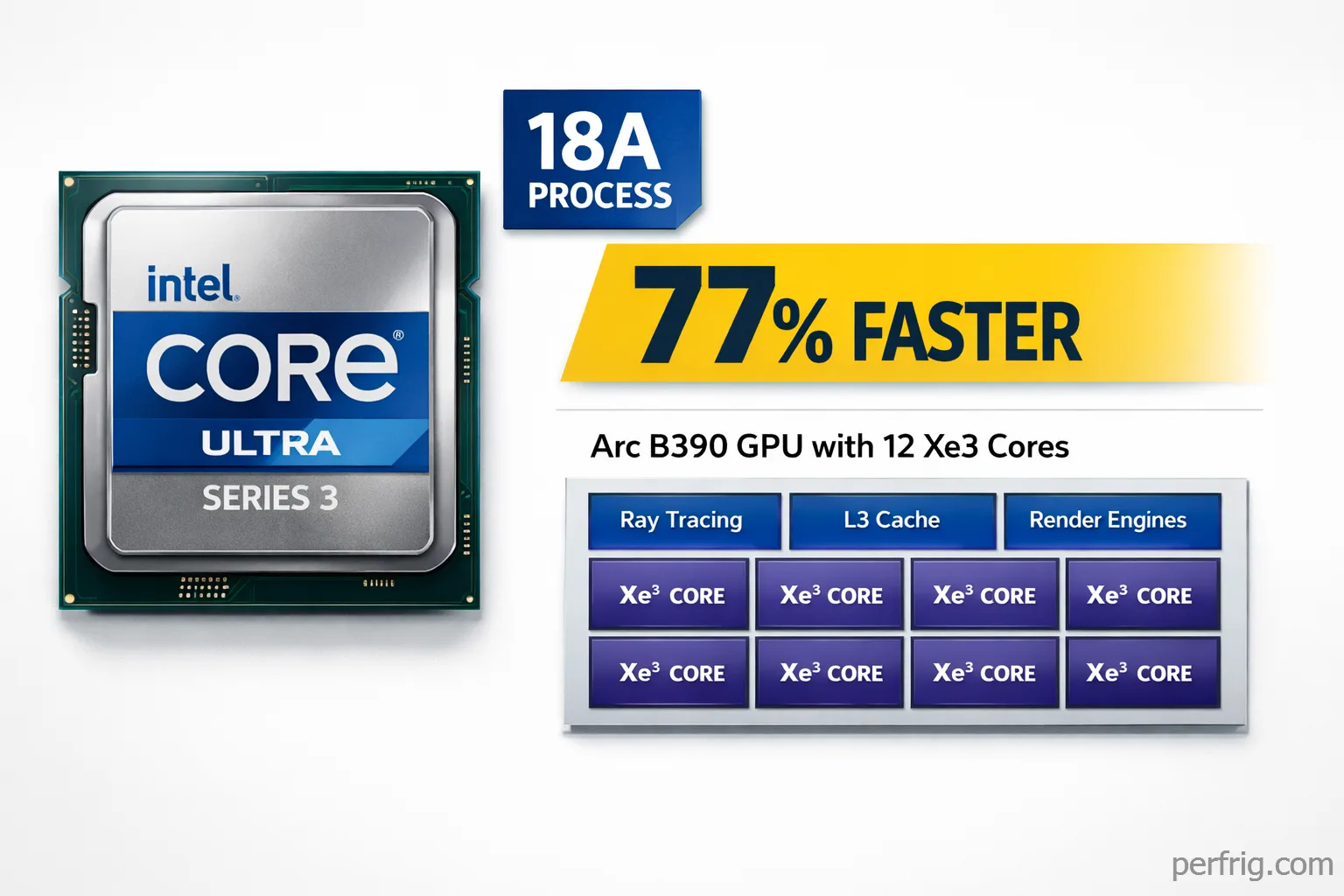
Intel unveiled Core Ultra Series 3 processors at CES 2026, marking the first consumer chips built on the company’s Intel 18A manufacturing process. The new “Panther Lake” lineup delivers integrated graphics powerful enough to challenge discrete GPUs from 2024 while maintaining the thin-and-light form factors that defined previous generations.
Intel 18A: Made in America, Competing Globally
Core Ultra Series 3 marks the debut of Intel 18A, what the company calls “the most advanced semiconductor process ever developed and manufactured in the United States.” The 18A node introduces two key technologies Intel has discussed for years: gate-all-around (GAA) transistors and backside power delivery.
GAA transistors replace FinFET designs with nanosheets that wrap around the channel from all sides, improving electrostatic control and reducing leakage. Backside power delivery moves power rails to the chip’s underside, freeing up front-side space for signal routing and reducing resistance.
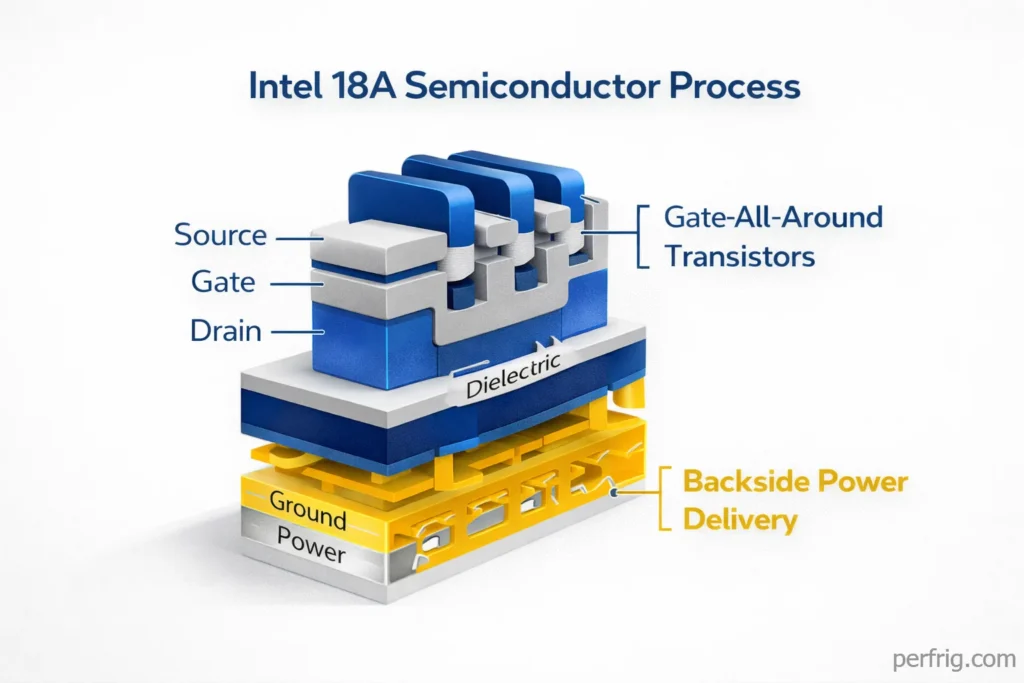
The result: better performance per watt than Lunar Lake while maintaining competitive thermals in thin chassis. Intel claims up to 60% better multi-threaded performance versus its previous-generation Core Ultra 9 288V, measured in Cinebench 2024 at 25W.
Arc B390: Integrated Graphics Go Discrete
The headline feature for gamers is Arc B390 integrated graphics, found in the new Core Ultra X9 and X7 processors. This iGPU packs 12 Xe3 cores running at 2.5 GHz—a configuration approaching Intel’s discrete Arc B570 desktop card, which uses 18 Xe2 cores at the same clock speed.
Intel claims 77% faster gaming performance versus Lunar Lake’s integrated graphics when measured across 45 titles at 1080p High settings with 2x upscaling. More impressively, early hands-on testing showed the Arc B390 delivering playable framerates in current AAA titles without needing a discrete GPU.
Battlefield 6 ran above 120 FPS at 1080p High settings during press demos. Dying Light: The Beast hit 196 FPS under similar conditions. Cyberpunk 2077, notoriously demanding even on high-end hardware, managed 80+ FPS at 1080p High without path tracing enabled.
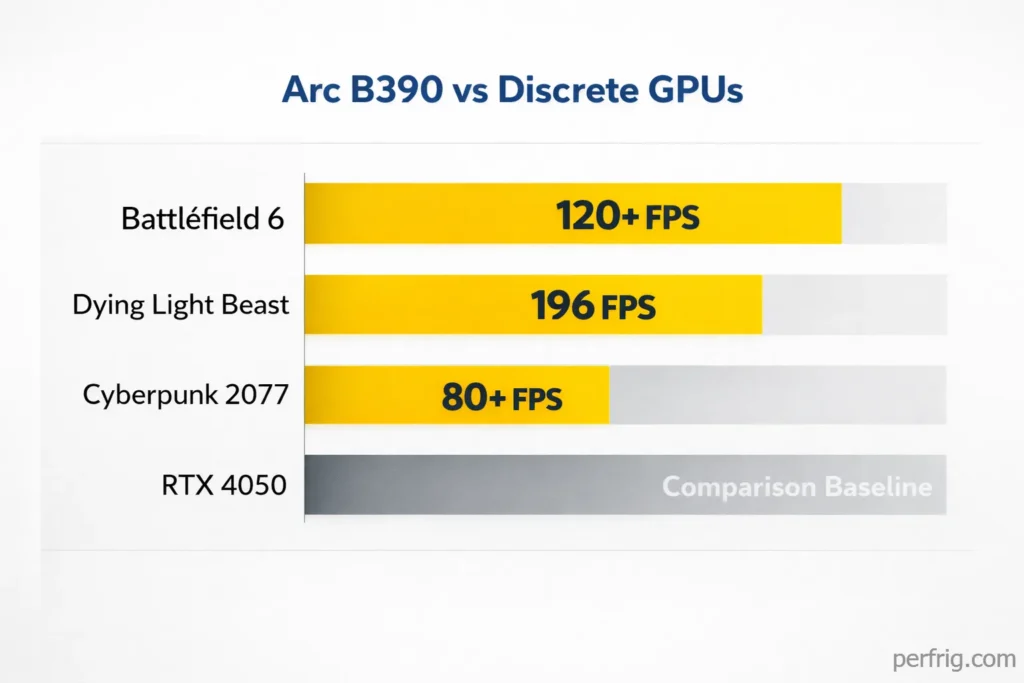
These numbers put the Arc B390 in range of NVIDIA’s RTX 4050 mobile GPU from 2024—a discrete chip that required its own memory, power budget, and thermal solution. Intel’s solution runs entirely on shared system memory and fits within the same 80W maximum package power as previous ultra-thin laptop processors.
The Arc B390 supports modern rendering features including hardware ray tracing, Intel XeSS 3 upscaling, and multi-frame generation up to 4x. XeSS 3 frame generation works similarly to NVIDIA’s DLSS and AMD’s FSR, interpolating additional frames between rendered ones to boost perceived smoothness.
X-Series: Intel’s Answer to Gaming Laptops
Intel introduced new “X” branding for processors with the most powerful integrated graphics. Three models carry this designation: Core Ultra X9 388H, Core Ultra X7 368H, and Core Ultra X7 358H. All three include the full 12-core Arc B390 iGPU.
The X9 388H tops the stack with 12 CPU cores (4 P-cores, 8 E-cores, 4 low-power E-cores), a 4.9 GHz maximum boost clock, and support for up to 96GB of LPDDR5X-9600 memory. That memory speed represents a strategic advantage over AMD’s Ryzen AI HX processors, which typically ship with slower LPDDR5X-7500 or LPDDR5X-8000.
Memory bandwidth matters significantly for integrated graphics, which share system RAM rather than having dedicated VRAM. The faster memory helps explain Intel’s performance claims against AMD, where similar GPU architectures often show different results based purely on memory configuration.
The X-series chips sacrifice PCIe lanes to accommodate the larger GPU. Where standard Core Ultra 9 processors offer 20 PCIe lanes (12 Gen 5, 8 Gen 4), the X9 388H drops to 12 lanes total, with 8 dedicated to the iGPU. This trade-off makes sense for thin laptops without discrete GPUs but limits expandability.
Product Stack: 14 SKUs for Every Segment
Beyond the X-series, Intel announced 11 additional Core Ultra Series 3 models covering performance tiers from mainstream to ultra-portable. The full lineup includes Core Ultra 9, 7, and 5 variants, each with different CPU core counts and GPU configurations.
Core Ultra 9 386H matches the X9 388H’s CPU configuration but uses a smaller 4-core “Intel Graphics” iGPU instead of Arc branding. This version offers 20 PCIe lanes instead of 12, making it better suited for laptops with discrete GPUs where the integrated graphics primarily handle productivity tasks.
Core Ultra 7 models range from 12-core to 10-core configurations, with some receiving the Arc B370 iGPU (8 Xe3 cores) and others getting standard Intel Graphics with 4 Xe cores. Intel’s tile-based architecture allows flexible mix-and-match configurations, letting laptop manufacturers choose the optimal balance of CPU, GPU, and connectivity for their designs.
Core Ultra 5 processors drop to 8-core CPU configurations but maintain competitive specifications for mainstream laptops. The Core Ultra 5 336H, for example, offers an 8-core CPU with a 4.6 GHz boost and 18MB of L3 cache—plenty for typical productivity workloads and casual gaming with XeSS upscaling.
Intel also announced non-Ultra “Core” processors leveraging the same architecture at lower price points. These chips enable Series 3 technology in budget laptops without
the AI-focused marketing and premium pricing of Ultra branding.
Competition: Intel vs AMD vs Qualcomm
Intel positions Series 3 directly against AMD’s Ryzen AI 9 HX 370 and Qualcomm’s Snapdragon X Elite. In Intel’s benchmarks, the Core Ultra X9 388H claims 82% faster gaming performance than AMD’s Strix Point at 1080p native rendering without upscaling.
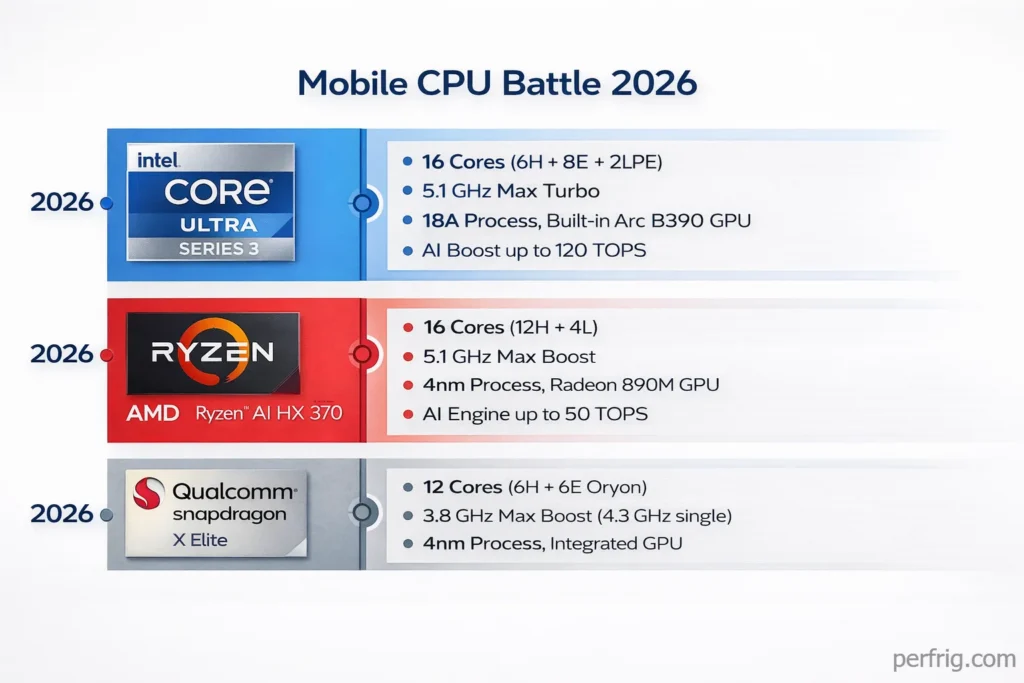
The comparison becomes more complex with Qualcomm, where Intel focuses on battery life and x86 app compatibility. Qualcomm’s ARM-based chips excel at efficiency but struggle with gaming due to translation layers and limited driver support. Intel leverages x86’s ecosystem advantage while closing the efficiency gap through architectural improvements.
AMD’s advantage lies in its Radeon 890M integrated graphics, which delivered strong performance in Ryzen AI 9 HX 370 laptops throughout 2025. However, AMD typically pairs these chips with slower memory, giving Intel’s faster LPDDR5X-9600 configuration an edge in bandwidth-sensitive scenarios.
Battery life comparisons favor Intel’s marketing claims but require real-world validation. Intel cites up to 27 hours of Netflix streaming on the X9 388H, measured on a reference Lenovo design. Actual results will vary dramatically based on battery capacity, display technology, and usage patterns.
Edge Computing: Series 3 Goes Industrial
For the first time, Intel certified Core Ultra processors for embedded and industrial applications. Series 3 edge processors support extended temperature ranges, deterministic performance requirements, and 24/7 reliability specifications needed for robotics, medical devices, and smart city infrastructure.
Intel demonstrated edge applications at CES, comparing the Core Ultra X9 388H against NVIDIA’s Jetson Orin AGX kit in robotics workloads. The comparisons showed significant advantages in large language model performance (1.9x faster), video analytics (2.3x better performance per watt per dollar), and vision language models (4.5x higher throughput).
These benchmarks target specific use cases where integrated AI acceleration provides advantages over traditional discrete GPU solutions. Edge systems powered by Core Ultra Series 3 will be available starting Q2 2026, giving Intel a foothold in markets where it previously lacked competitive options.
Availability and Ecosystem
Pre-orders for Core Ultra Series 3 laptops began January 6, with retail availability starting January 27 and continuing throughout the first half of 2026. Intel claims over 200 laptop designs from partners including Lenovo, Dell, HP, Asus, and Acer.
Early systems showcased at CES demonstrated the technology’s potential. Lenovo’s prototypes paired the X9 388H with 32GB of LPDDR5X-9600 in 14-inch form factors weighing under 3 pounds. These ultra-portables delivered gaming performance previously requiring much larger, heavier gaming laptops with discrete GPUs and compromised battery life.
Pricing remains unclear as Intel doesn’t set retail prices—laptop manufacturers make those decisions. However, the Arc B390’s capabilities suggest premium pricing for X-series models, potentially competing with thin-and-light gaming laptops in the $1,500-$2,000 range.
The Bigger Picture: Intel’s Comeback Story
Core Ultra Series 3 represents more than a product launch. It’s the public debut of Intel 18A, the process node that determines whether Intel can compete with TSMC and Samsung in leading-edge semiconductor manufacturing. The company bet its future on 18A delivering, and Series 3 provides the first consumer validation of that bet.
Intel’s decision to manufacture these chips domestically carries strategic significance. While competitors rely on Asian foundries, Intel maintains US production capacity, insulating it from geopolitical supply chain risks. The trade-off: higher costs and lower initial yields as the 18A process matures.
The laptop market’s shift toward integrated graphics plays into Intel’s strengths. Apple’s success with M-series chips demonstrated that well-designed integrated solutions can replace discrete GPUs for many users. AMD’s Ryzen AI processors followed this trend. Intel now has competitive technology, backed by the x86 ecosystem’s software compatibility.
The Bottom Line
Intel Core Ultra Series 3 launches with strong specifications, impressive demo performance, and strategic positioning against AMD and Qualcomm. The Arc B390 integrated graphics delivers a genuine leap over previous generations, finally making integrated solutions viable for moderate gaming.
Real-world validation requires independent reviews with retail hardware. Early hands-on impressions suggest Intel’s claims hold up, but battery life, thermal performance, and driver stability will determine whether Series 3 succeeds in practice.
Pre-orders start this week, with retail availability later this month. For anyone considering an ultra-portable laptop in 2026, Core Ultra Series 3 with Arc B390 graphics deserves serious consideration—especially if your gaming needs don’t require maximum settings at 1440p or above.
Intel’s 18A process finally shipped in consumer products. That alone makes Core Ultra Series 3 one of CES 2026’s most significant announcements, regardless of how well it performs against competitors. The technology works, the chips exist, and they’re coming to retail systems this month. Everything else is execution.