
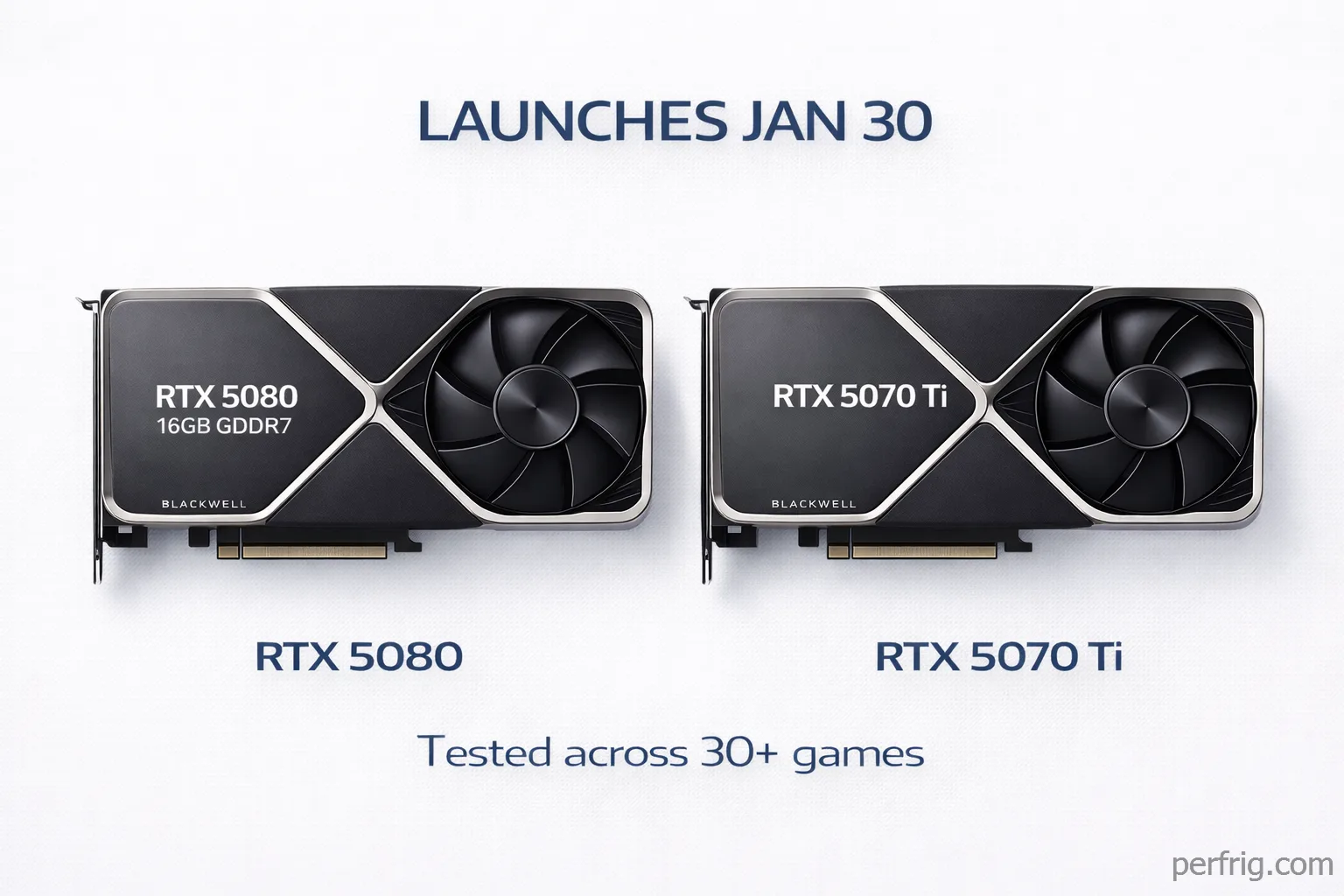

RTX 5080 and 5070 Ti launch today: pricing, specs, and availability
CONTENTS
NVIDIA’s GeForce RTX 5080 and RTX 5070 Ti graphics cards launched on January 30, 2026, bringing Blackwell architecture to the mid-range gaming market. The RTX 5080 arrives at $999 MSRP while the RTX 5070 Ti debuts at $749 MSRP, positioning both cards as alternatives to the flagship RTX 5090 that launched earlier this month. The RTX 5070 follows in February at $599 MSRP, completing NVIDIA’s mid-range lineup.
Both GPUs launched with immediate availability concerns mirroring the RTX 5090’s problematic rollout. Early reports indicate limited stock at major retailers, with AIB partner models priced significantly above MSRP. The launches occur without competition from AMD, whose RDNA 4 architecture remains delayed until Q2 2026.
RTX 5080 specifications and positioning
The RTX 5080 features 10,752 CUDA cores built on NVIDIA’s Blackwell architecture, utilizing the GB203-400-A1 chip. The card includes 16GB of GDDR7 memory operating at 960 GB/s bandwidth across a 256-bit interface—a 34% bandwidth increase over the RTX 4080’s 717 GB/s despite maintaining the same memory bus width. The GPU operates at 2.30 GHz base clock with 2.62 GHz boost clocks.
NVIDIA equipped the RTX 5080 with fourth-generation RT cores for ray tracing and fifth-generation Tensor cores for AI workloads including DLSS 4 Multi Frame Generation. The card draws 360W under load, requiring an 850W power supply minimum and the 12V-2×6 power connector.
Performance testing shows the RTX 5080 delivering 10-15% improvements over the RTX 4080 Super in traditional rasterization workloads. With DLSS 4 Multi Frame Generation enabled, NVIDIA claims up to 2X performance gains, though this feature currently supports only 15 games at launch. Ray tracing performance shows 15-25% improvments over previous generation cards.
The RTX 5080 positions between the $1,999 RTX 5090 and the $749 RTX 5070 Ti in NVIDIA’s product stack. The $999 MSRP matches the RTX 4080 Super’s launch price from early 2025, avoiding the pricing controversy that plagued the original RTX 4080’s $1,199 debut.
RTX 5070 Ti specifications and market positioning
The RTX 5070 Ti launches at $749 MSRP, featuring 16GB of GDDR7 memory and 896 GB/s total memory bandwidth—a 78% increase over the RTX 4070 Ti’s 504 GB/s. NVIDIA positions the card as capable of 1440p gaming with full ray tracing enabled, citing Alan Wake 2, Black Myth: Wukong, and Cyberpunk 2077 as target titles.
The RTX 5070 Ti utilizes a cut-down GB203 chip similar to the RTX 5080, though NVIDIA has not disclosed exact CUDA core counts. The card supports DLSS 4 Multi Frame Generation and features the same fourth-generation RT cores and fifth-generation Tensor cores as the RTX 5080.
At $749, the RTX 5070 Ti sits $250 below the RTX 5080, creating a significant price gap in NVIDIA’s mid-range lineup. Early performance data suggests the card delivers 2X the performance of the RTX 4070 Ti with DLSS 4 enabled, though traditional rasterization improvements remain more modest.
Availability and pricing reality
Both cards launched on January 30, 2026, with NVIDIA Founders Edition and AIB partner models. Initial availability proved extremely limited, repeating RTX 5090’s supply constraints.
AIB partner models list between $1,100 and $1,799 for the RTX 5080, significantly exceeding $999 MSRP. Current market tracking shows actual prices ranging from $1,183 to $1,300+ depending on model and retailer.
Major retailers offered notification systems rather than traditional pre-orders. Supply constraints appear tied to TSMC production capacity on the custom 4N process node. Widespread availability likely won’t stabilize until March 2026 according to industry analysts.
RTX 5070 launch scheduled for February
NVIDIA confirmed the RTX 5070 will launch in February 2026 at $599 MSRP. The card features 12GB of GDDR7 memory and 672 GB/s bandwidth compared to the RTX 4070’s 504 GB/s.
The RTX 5070 targets 1440p gaming as the sweet spot, offering the most affordable entry to Blackwell architecture and DLSS 4 support. At $599, it undercuts the RTX 5070 Ti by $150 and the RTX 5080 by $400, potentially offering the best value proposition in NVIDIA’s new lineup.

AMD absence creates competitive void
AMD’s delayed RDNA 4 architecture leaves NVIDIA without direct competition during the RTX 50 series mid-range launches. The Radeon RX 9070 XT and RX 9070, originally expected in Q1 2026, now target Q2 2026 release windows.
The competitive void removes pricing pressure on NVIDIA’s mid-range offerings. The RTX 5080 at $999 and RTX 5070 Ti at $749 face no direct challengers, allowing NVIDIA to maintain premium positioning without adjusting for competitive threats.
AMD’s RX 7900 XTX remains available at $850-950 street pricing, offering an alternative for buyers prioritizing traditional rasterization performance over ray tracing and DLSS features. The lack of new AMD products until Q2 2026 extends NVIDIA’s market dominance through at least early spring.
Intel’s Arc Battlemage GPUs including the B580 target the budget segment below $300, avoiding direct competition with NVIDIA’s mid-range offerings. The B580 sold out quickly following its launch, indicating strong demand for alternatives to NVIDIA’s pricing but not providing options at the $600-1000 price tier.
DLSS 4 and software positioning
NVIDIA heavily markets DLSS 4 Multi Frame Generation as a key differentiator, generating up to three AI frames between rendered frames. Current game support remains limited to approximately 15 titles at launch.
DLSS 4 introduces 20-30ms additional latency, making it suitable for single-player games but problematic for competitive multiplayer. The technology remains exclusive to RTX 50 series cards, creating software lock-in for maximum AI-upscaled performance.
What gamers should know
The RTX 5080 at $999 MSRP offers modest improvements over the RTX 4080 Super for users prioritizing traditional rasterization performance. Buyers seeking 10-15% generation-over-generation gains may find better value in discounted RTX 40 series cards or waiting for increased supply and potential price drops.
The RTX 5070 Ti at $749 provides a middle option between the RTX 5080 and forthcoming RTX 5070, though the $150 price gap to the RTX 5070 may make the lower-tier card more attractive depending on performance scaling.
Availability constraints suggest waiting until March 2026 for stable stock and potentially lower AIB partner pricing. Current $1,183-1,300+ street prices for the RTX 5080 significantly exceed MSRP, making immediate purchases questionable value propositions.
RTX 4080 Super owners gain minimal performance improvements from upgrading to the RTX 5080. RTX 3080 or older GPU owners see 40-60% performance gains justifying upgrades, particularly for 4K gaming or content creation workloads.
The February RTX 5070 launch may offer the best value in NVIDIA’s new mid-range lineup at $599, assuming availability improves and AIB partner pricing remains reasonable. The RTX 5070’s positioning as the entry point to Blackwell architecture could make it the most compelling option for mainstream gaming builds.

