
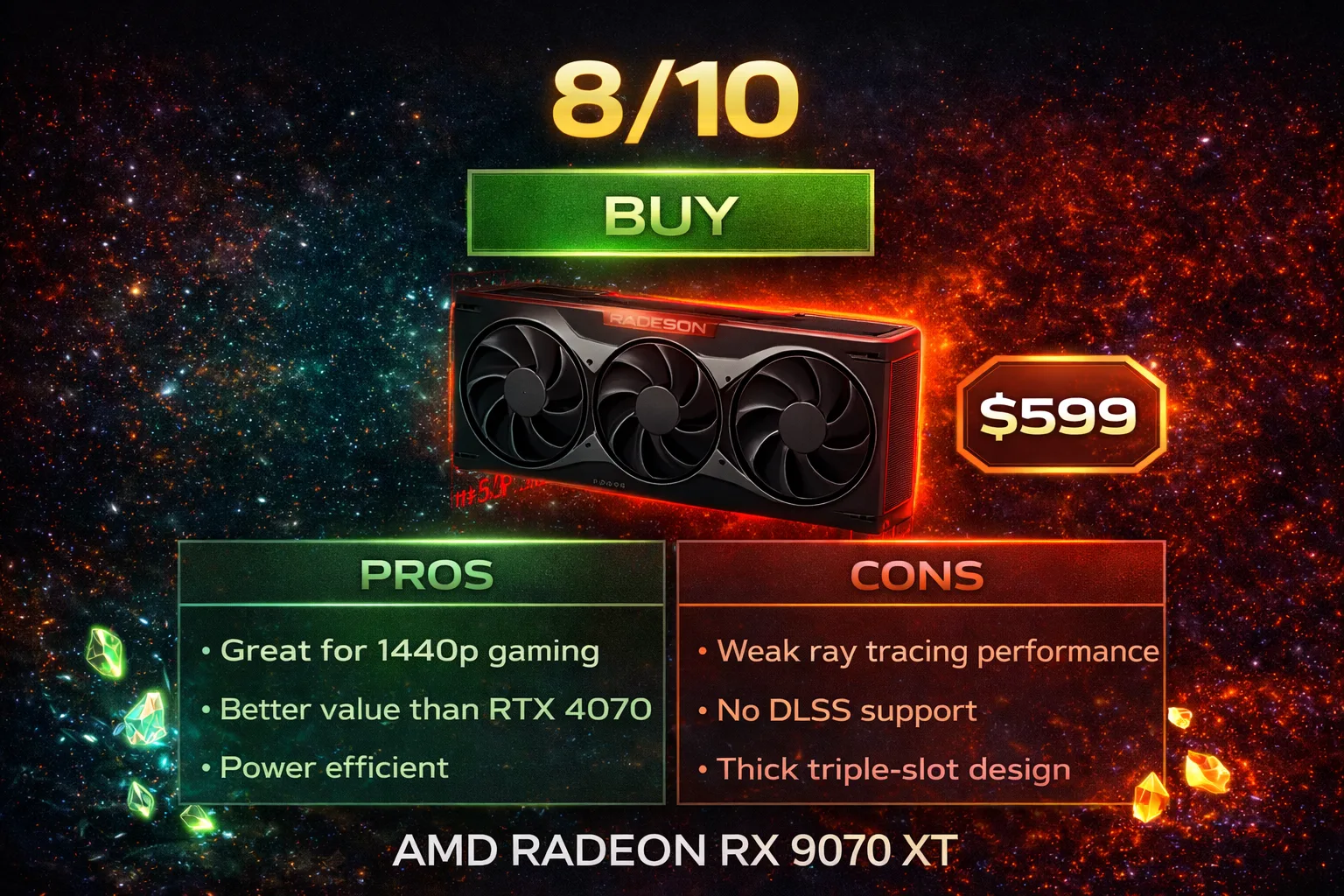
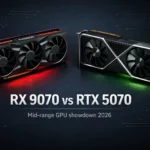
AMD needed this one. After RDNA 3 landed with more noise than substance and left mid-range buyers wondering if the green team had just permanently pulled ahead, the RX 9070 XT is a direct answer to that question. And honestly? It’s a good answer.
The card sits at $599. It’s targeting the RTX 5070 Ti at $749. That’s the whole story in one sentence, but let’s get into the specifics.
specs and where it sits
The RX 9070 XT runs RDNA 4 architecture, 16GB of GDDR6 memory, 256-bit bus, and a boost clock around 3.0GHz. AMD has made real improvements to the shader architecture and to the AI accelerators powering FSR 4. On paper it looks like a meaningful generational step. In practice, it is.
What AMD changed under the hood matters here: the ray tracing hardware got a significant overhaul. RDNA 3 was embarrassingly behind NVIDIA on ray tracing performace. RDNA 4 closes that gap in a way that actually changes the conversation.
1080p and 1440p: the actual numbers
At 1080p, the RX 9070 XT is overkill for most people. It’s pushing well above 144fps in basically everything at max settings. If you’re on a 1080p monitor, you’re not the target here.
1440p is where this card makes sense. In rasterization-heavy titles like Cyberpunk 2077, Spider-Man 2, and Alan Wake 2 without ray tracing, the 9070 XT sits within 5-8% of the RTX 5070 Ti at comparable settings. In some titles it’s essentially tied. For a card that costs $150 less, that’s a real achievement.
The RTX 5070 Ti pulls ahead more noticeably in CPU-bound scenarios and in titles that benefit heavily from DLSS 4.5’s quality improvements. But in raw rasterization at 1440p max settings, the gap is genuinely small.
ray tracing: still behind, but not embarrassingly so
Real talk: if ray tracing is your priority, NVIDIA still wins. That hasn’t changed.
What has changed is the margin. RDNA 3’s ray tracing performance was bad enough that enabling RT meant dropping to medium settings just to stay playable. RDNA 4 is different. In Cyberpunk 2077 with path tracing at 1440p, the 9070 XT delivers playable framerates where FSR 4 can carry the load. Without upscaling, it still trails the 5070 Ti by around 20-25% in heavy RT workloads.
For players who want RT effects at 1440p and are willing to use FSR 4, the experience is now genuinely solid. For players who want native 4K path tracing, this isn’t the card and NVIDIA still owns that space.
FSR 4 in practice
This is where RDNA 4 changes things in a way the spec sheet doesn’t fully capture.
FSR 4 is not FSR 3. The machine learning model running on RDNA 4’s AI accelerators produces image quality that’s meaningfully better than anything AMD has shipped before. At Quality mode on a 1440p target, the output is close enough to native that you have to be looking carefully in motion to spot the difference.
The practical impact: the 9070 XT’s effective performance at 1440p with FSR 4 Quality mode is higher than raw benchmarks suggest. You’re getting quality-tier upscaling that was previously only available to NVIDIA users, and the performance headroom it creates makes the card feel faster than the native numbers alone.
DLSS 4.5 is still the better technology, especially at more aggressive upscaling modes. But FSR 4 on RDNA 4 is no longer a concession. It’s a genuine option.
value verdict vs RTX 5070 Ti
Here’s the question: does saving $150 make sense?
In rasterization at 1440p: yes, absolutly. You’re giving up 5-8% average performance for 20% less money. That math works.
In ray tracing heavy workloads: the gap widens to 20-25%. If your library is full of RT-focused titles, that $150 difference starts to matter more.
In upscaling quality: DLSS 4.5 is better than FSR 4. If you’re committed to using upscaling as a core part of your setup, the 5070 Ti offers the stronger package.
The RTX 5070 Ti is the better GPU. It’s faster across the board, has better ray tracing, and comes with the best upscaling technology available right now. If money isn’t the constraint, it wins.
But money is usually the constraint. And the RX 9070 XT at $599 is the first AMD mid-range card in two generations that doesn’t require a discount or an apology to recommend. It’s fast, it runs cool, FSR 4 is a real upgrade, and the ray tracing situation has improved enough that it’s no longer a hard dealbreaker.
For 1440p gaming at $599, this is the best value option on the market right now. AMD didn’t just close the gap with RDNA 4. They made you actually think about the trade-off.
Verdict: BUY Score: 8/10
pros: excellent 1440p rasterization, FSR 4 is genuinely competitive, $150 cheaper than the 5070 Ti, improved ray tracing vs RDNA 3, 16GB VRAM at this price cons: DLSS 4.5 still ahead in upscaling quality, 5070 Ti leads in RT-heavy workloads, FSR 4 requires RDNA 4 (older AMD cards get FSR 3)







Join the Discussion