
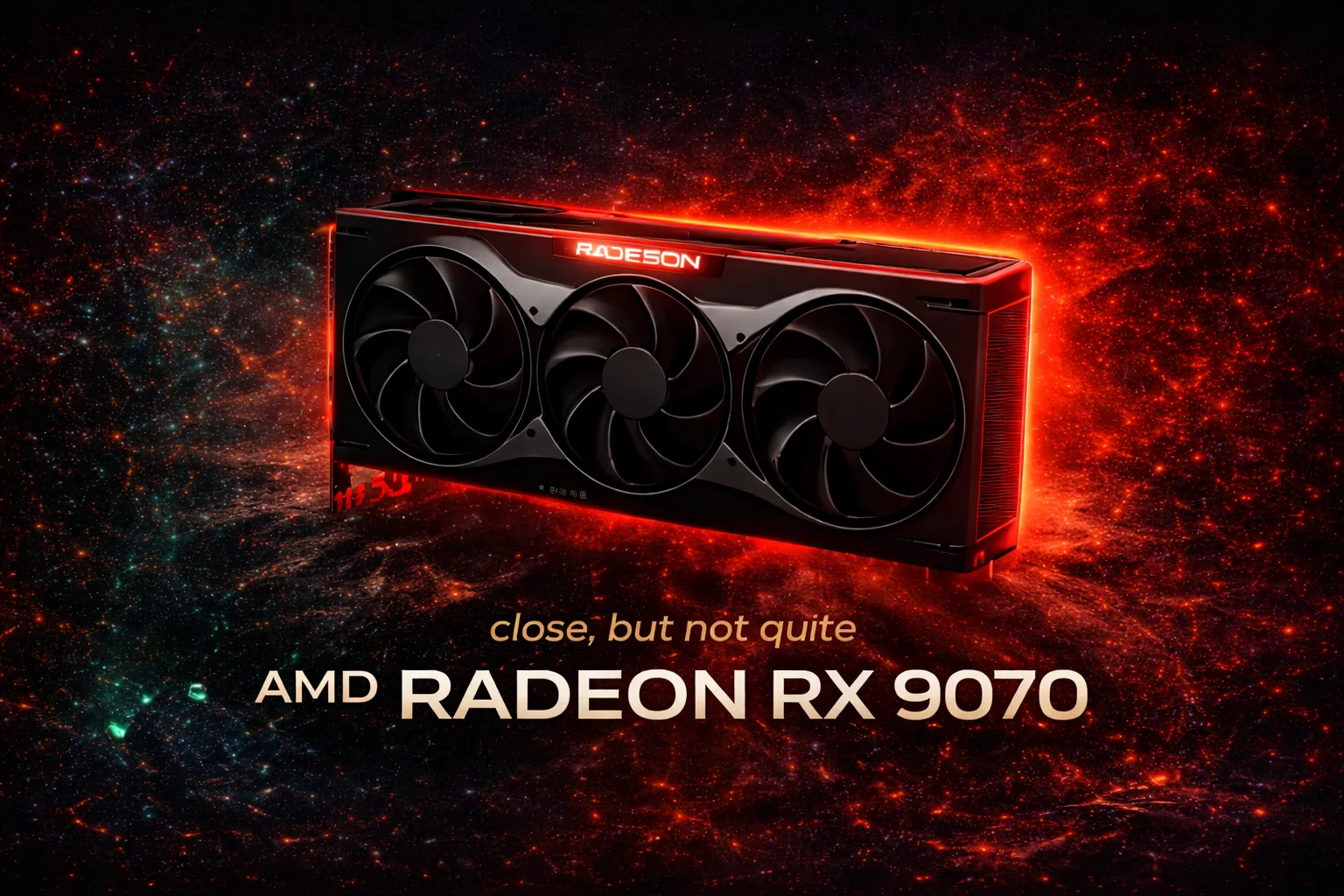
Look, the RX 9070 is a genuinely good GPU. Strong raster performance, excellent efficiency, 16GB VRAM at $549 MSRP. The problem isn’t what it is. The problem is what it sits next to. For $50 more you get the RX 9070 XT, and that changes the entire conversation around this card.
Verdict summary
| Category | Details |
|---|---|
| Pros | Strong 1440p raster performance, excellent power efficiency, 16GB VRAM at this price, RDNA 4 ray tracing improvements, runs cool and quiet |
| Cons | 9070 XT exists at $599, gap between the two is larger than the price differance suggests, limited ray tracing uplift vs XT, no FSR 4 advantage over XT |
| Verdict | CONSIDER |
| Score | 7/10 |
Where the RX 9070 fits in the market
RDNA 4 is AMD’s clearest architectural statement in years. They stepped back from flagship territory and put their engineering effort into the mid-range, and it shows. The RX 9070 and 9070 XT are the only RDNA 4 cards at launch, both targeting the $500-$600 segment where most GPUs actually get sold.
The RX 9070 slots in at $549 MSRP. That puts it directly against the RTX 5070 at the same price point, which is a fight AMD wins in most raster workloads. It positions below the 9070 XT at $599. The 9070 XT is where AMD’s real story lives, and the vanilla 9070 is essentially the lower-yield alternative that fills out the product stack.
That context matters because it shapes how you should think about this card. It’s not a bad product. It’s a product that exists in the shadow of a better one that costs almost the same amount.
Gaming performace at 1440p
At 1440p, which is where this card belongs, the RX 9070 delivers. Across a wide range of titles, you’re looking at consistent performance in the 90-110 FPS range on high settings without upscaling. Demanding open world titles sit comfortably at 60-75 FPS maxed. For a $549 GPU, that’s a legitimate mid-to-high range result.
The comparison against the RTX 5070 is interesting. In raster-heavy titles, the RX 9070 leads or matches the RTX 5070. AMD’s architectural efficiency in rasterization with RDNA 4 translates to real-world results here. For players who primarily play raster games and don’t need DLSS specifically, the RX 9070 at equivalent pricing is the stronger buy.
Against the previous generation, the RX 9070 clears the RX 7800 XT by roughly 35-40% in most titles. That’s a meaningful generational jump. Owners of older mid-range cards from two generations back are looking at a substantial upgrade.
The RX 9070 vs RX 9070 XT gap
Here’s the problem. The 9070 XT outperforms the 9070 by 9-14% depending on the title, for a 9% price premium. That math doesnt favor the non-XT version. You’re paying 91% of the price for roughly 87-90% of the performance. In a vacuum that’s not terrible, but when both cards are on the shelf next to each other at $549 and $599, the choice becomes obvious.
The gap widens in ray tracing workloads. Both cards benefit significantly from RDNA 4’s improved RT architecture compared to RDNA 3, but the XT’s additional compute units create a larger lead in RT-heavy scenarios. If you play games with ray tracing enabled, the XT pulls further ahead.
The VRAM situation is identical. Both cards carry 16GB GDDR6 on a 256-bit bus. That’s one area where the non-XT doesn’t lose anything, and it’s genuinely a strong point for both cards relative to NVIDIA’s 12GB offering at comparable prices.
RDNA 4 efficiency: the real story
Honestly, the efficiency numbers are where RDNA 4 impresses most. The RX 9070 runs at reasonable power targets and delivers competitive temperatures across third-party board partner designs. Junction temperatures in testing across multiple cards sit well within comfort zones. This is a card you can run in a mid-tower with decent airflow without thermal concerns.
The performance-per-watt improvement over RDNA 3 is substantial. AMD’s 4nm process node did real work here. For builders who care about power consumption or system temperatures, RDNA 4 is a meaningful step forward from the previous generation, and the RX 9070 reflects that across the entire product line.
FSR 4 and upscaling
Both RX 9070 cards support FSR 4, AMD’s latest upscaling technology. At 1440p with FSR 4 Quality mode enabled, the performance headroom opens up considerably. FSR 4 represents a genuine quality improvement over FSR 3, with noticeably sharper output and better motion handling. It’s not DLSS 4, but the gap has narrowed.
The upscaling story doesn’t differentiate the 9070 from the 9070 XT in any meaningful way. Both support the same features at the same quality levels. If FSR 4 compatibility is your primary concern, either card delivers identically.
Buy, skip, or consider
The RX 9070 at strict MSRP of $549 is a reasonable purchase for 1440p gaming if the 9070 XT is unavailable or priced above $620 at retail. At that gap, the non-XT version makes sense.
The problem is that in the current market, both cards are often available near MSRP, which makes the decision straightforward. Spend the extra $50. The 9070 XT is the better card by a larger margin than the price gap suggests, and you’ll have it for three or four years.
The RX 9070 earns a CONSIDER rather than a BUY specifically because of what sits one step above it. As a standalone GPU reviewed in isolation, it’s a 7 or 8 out of 10. In the context of the product stack it actually lives in, the $50 to the XT is almost always the right call.
Score: 7/10







Join the Discussion