
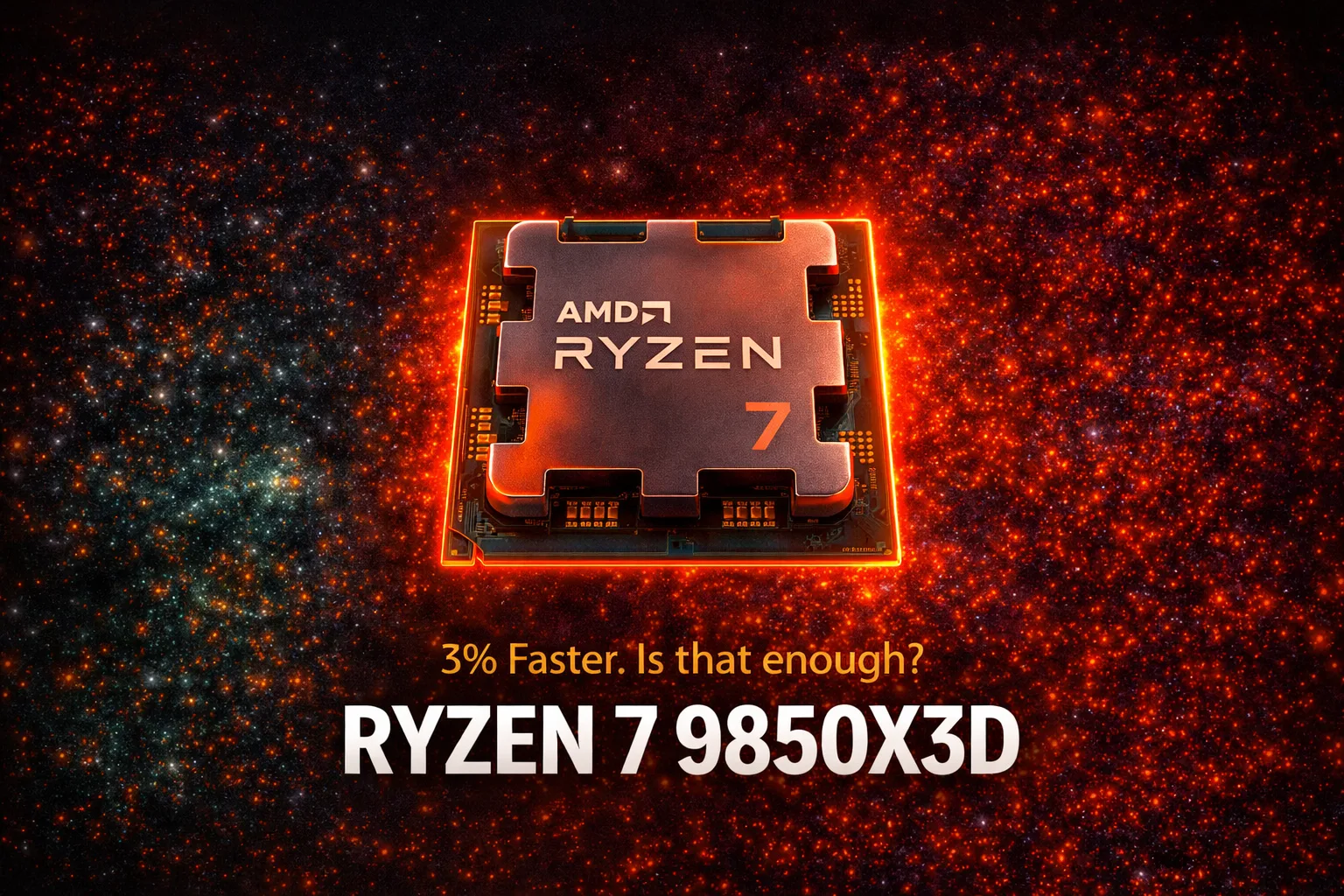
Yes. By about 3%. Here’s the problem.
The 9850X3D is technically the fastest gaming CPU on the planet right now. AMD announced it at CES 2026, launched it at $499, and it does exactly what it says: 400MHz more boost clock than the 9800X3D, same 96MB 3D V-Cache, same 8-core Zen 5 architecture. The world’s fastest gaming CPU, again. The question is whether “technically faster” translates into anything you can actually feel, and the answer is almost entirely no.
The clock speed vs cache trade-off
Here’s where it gets interesting. The 9800X3D’s edge over everything Intel has shipped comes almost entirely from the 3D V-Cache, not raw clock speed. The cache holds more game data close to the CPU cores, which reduces latency and keeps the pipeline fed. The 9850X3D has the same cache. The same 96MB. The only differance is the boost clock ceiling: 5.6 GHz versus 5.2 GHz.
That 400MHz gap sounds significant. In practice, the 9850X3D does not actually sustain 5.6 GHz in most gaming workloads. Under real gaming loads, reviewers across multiple test benches saw the chip averaging 5.3 to 5.5 GHz, not materially above where a well-binned 9800X3D already runs. The cache does the heavy lifting. The clock speed bump is a small addition on top of a large foundation.
The tradeoff is power. The 9850X3D draws roughly 27 to 31% more power under load compared to the 9800X3D while running hotter. AMD listed the same 120W TDP for both chips, which does not reflect what reviewers observed in testing. The 9800X3D remains the more efficient part.
Gaming benchmark results
Real talk: the gap is 3% on average. In some games it reaches 5 to 7%, in others it is within margin of error.
The standout results appear in titles that are genuinely CPU-bound and benefit from the extra clock headroom. Baldur’s Gate 3 showed around 6% improvement at 1080p. Cyberpunk 2077 showed around 5%. These are the good cases. In the majority of titles, including most Unreal Engine 5 games, the gap between the 9850X3D and 9800X3D is 1 to 3%, and some are essentially identical.
Against Intel’s Core Ultra 9 285K, the story is the same as it was with the 9800X3D. The 285K is a capable processor that excels in multi-threaded workloads and productivity tasks, but it trails meaningfully in gaming benchmarks at 1080p where CPU performance is the bottleneck. The X3D architecture’s cache advantage in gaming is not something Intel has an answer for yet.
The comparison that actually matters for most buyers: the 9850X3D versus the 9800X3D. In every gaming benchmark across multiple test suites, the 9850X3D wins by 3% on average. That is not a number you see in frame rates. If the 9800X3D was giving you 160 FPS, the 9850X3D gives you 165.
Vs Intel Core Ultra 9 285K
The 285K costs around $400 to $420. The 9850X3D costs $499. The gaming performance gap favors AMD by 15 to 25% in CPU-heavy titles at 1080p. In multi-threaded productivity workloads, the 285K leads by 25 to 30% over the 9850X3D.
The right choice depends on one thing: what do you do with your PC? If you game primarily and want the absolute fastest gaming CPU, AMD wins. If you render, encode, compile, or run heavily-threaded workloads alongside gaming, the 285K or higher core-count Intel parts deliver substantially more value at lower cost.
The 285K is not a gaming CPU recommendation in 2026. But at $400 versus $499 for a chip that outperforms it in games by 3% more than the already-leading 9800X3D, it becomes an interesting alternative for anyone who does both gaming and serious productivity work.
Price premium justified?
No. Not over the 9800X3D.
The 9850X3D launched at $499. The 9800X3D is currently available around $460 to $470. You are paying $30 to $40 more for 3% average gaming performance improvement and meaningfully higher power draw. That math does not work in anyone’s favor except AMD’s.
Here’s the problem with framing it that way, though: if you are building a new system and not upgrading from an existing 9800X3D, the decision looks slightly different. At similar price points, the 9850X3D is the better buy. You are getting the fastest gaming CPU available, and the premium over the 9800X3D is small enough that it does not change the budget calculation significantly for a new build.
The value argument completely falls apart for existing 9800X3D owners. There is no justification for upgrading. You will not notice the differance in any game you play.
Who should upgrade or buy
Buy the 9850X3D if: you are building a new AM5 gaming PC, you want the fastest gaming processor available, and you have an RTX 5080 or 5090 that can actually surface CPU-level performance differences at high frame rates. At that level, 3% is real, even if it is not dramatic.
Buy the 9800X3D instead if: you are price-sensitive, you value efficiency, or you are doing any kind of productivity work alongside gaming. The 9800X3D is the better value and still the second-fastest gaming CPU on the planet.
Do not upgrade from a 9800X3D. This is not a meaningful generational step. It is a binned refresh of an existing chip with marginally higher frequencies.
Skip it entirely if: you are coming from anything below a 9800X3D and primarily care about gaming. The 7800X3D is still 15 to 24% behind the X3D Zen 5 parts, which is a real and noticeable gap. But the jump from 7800X3D to 9850X3D versus 9800X3D does not change the recommendation.
Pros: genuinly the fastest gaming CPU available, full AM5 compatibility, same efficient 3D V-Cache architecture, modest price premium over 9800X3D for new builds.
Cons: 3% gaming improvement over 9800X3D, 27 to 31% higher power draw, no value for existing 9800X3D owners, eight cores limits productivity performance vs Intel.
Verdict: consider for new builds. Skip if upgrading from a 9800X3D.
Score: 7/10












Join the Discussion