
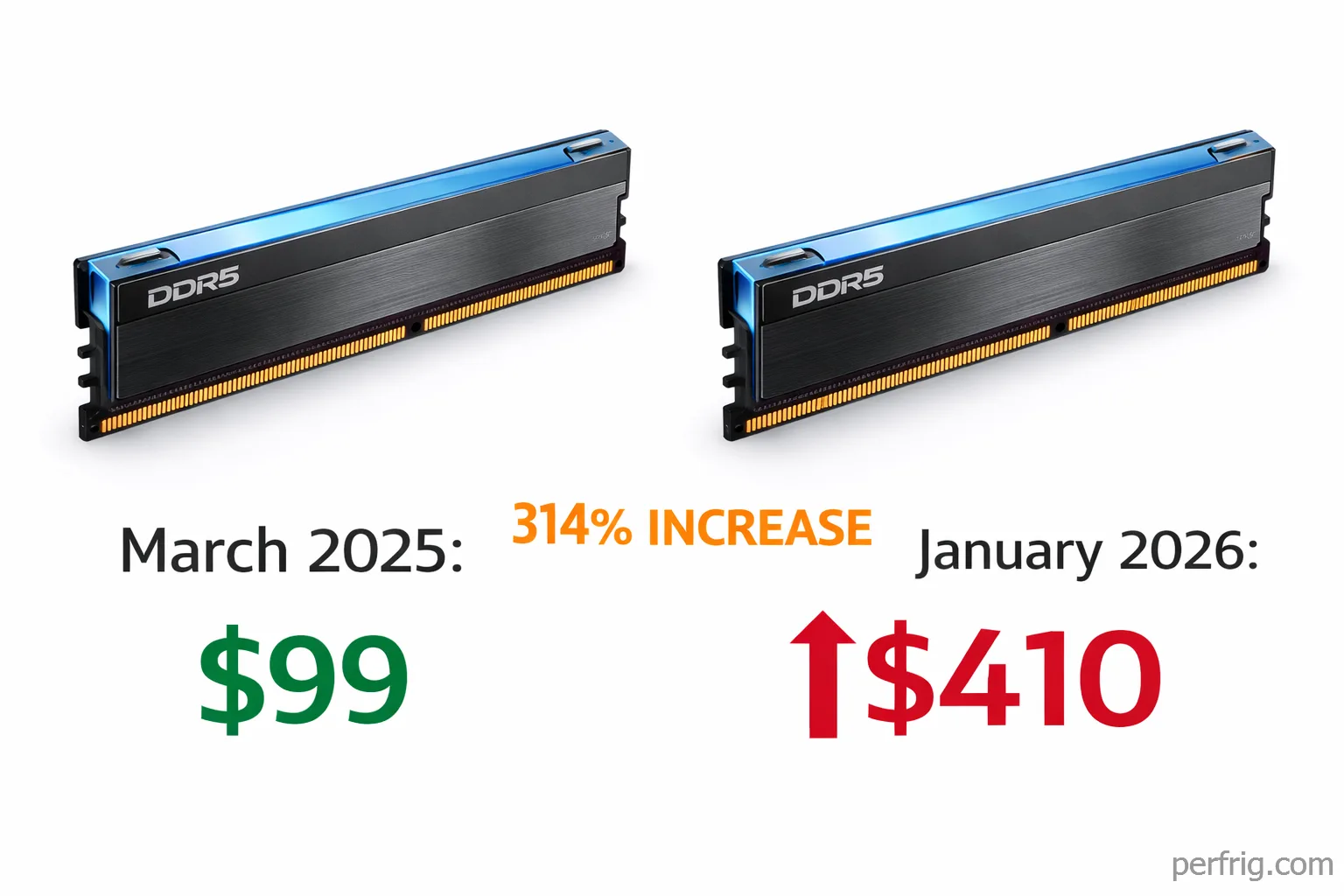
If you’ve been planning to build a gaming PC or upgrade your RAM lately, you’ve probably noticed something alarming: memory prices have gone completely insane. That DDR5-6000 32GB kit that cost $120 in spring 2025? It’s now selling for $410. DDR4 isn’t any better—prices have tripled in some cases, with certain kits becoming more expensive than DDR5.
This isn’t a temporary spike or a regional issue. We’re in the middle of a global memory crisis that analysts now expect to last through at least late 2027. For gamers and PC builders, this changes everything about how and when you should buy RAM.
Here’s what’s actually happening, why it matters, and what you can do about it.
The numbers are brutal
Let’s start with the cold, hard data. RAM prices have increased by an average of 123% throughout 2025, with another 30-50% surge projected for the first half of 2026. Some specific examples paint an even grimmer picture:

DDR5 Price Explosions:
- DDR5-6000 CL30 32GB: $99 (March 2025) → $410 (January 2026) = +314%
- DDR5-5600 32GB: $120 (May 2025) → $380 (December 2025) = +217%
- DDR5-6000 64GB: $210 (May 2025) → $750 (December 2025) = +257%
DDR4 Catching Up:
- DDR4-3600 32GB: $50 (May 2025) → $170 (December 2025) = +240%
- DDR4-3600 64GB: $180 (May 2025) → $470 (December 2025) = +161%
In some cases, DDR4 has become more expensive than DDR5 due to severe scarcity. This “price inversion” is forcing system builders to migrate to DDR5 whether they want to or not, further straining the already limited DDR5 supply.
Individual memory chips tell the same story. A single 16Gb DDR5 chip that cost $6.84 in September 2025 jumped to $27.20 by December—a 298% increase in just three months. At that rate, the cost of components alone for a 16GB module is now around $217, before adding PCB, assembly, testing, or any profit margin.
Why this is happening
The root cause is simple but massive: artificial intelligence. AI data centers are devouring memory at a scale the industry has never seen, and memory manufacturers are redirecting production capacity to meet that demand.

The AI memory boom
Training and running large language models requires enormous amounts of memory. When companies like Microsoft, Google, and Meta build AI infrastructure, they’re not buying dozens of servers—they’re buying thousands, each packed with high-bandwidth memory (HBM) and massive pools of DDR5 RAM.
HBM production is especially profitable for manufacturers like Samsung, SK Hynix, and Micron. These specialized memory chips for AI accelerators (like NVIDIA’s H100 and H200 GPUs) sell for significantly higher margins than regular DDR5. As a result, manufacturers have reallocated more than three times the wafer capacity to produce HBM compared to conventional DRAM.
Every wafer allocated to an HBM stack for an NVIDIA GPU is a wafer denied to the DDR5 module in your gaming PC. It’s a zero-sum game, and consumer electronics are losing.
The DDR4 phase-out disaster
Making matters worse, memory manufacturers deliberately started phasing out DDR4 production throughout 2025. The plan was to push the market toward DDR5 while freeing up fabrication capacity for more profitable products.
This created an unexpected crisis. Millions of systems worldwide still rely on DDR4, and the sudden supply reduction caused prices to spike dramatically. Samsung briefly announced an end-of-life schedule for DDR4, then partially delayed it due to long-term contracts with enterprise customers—but that relief doesn’t extend to regular consumers or PC builders.
The result is a market where legacy memory isn’t becoming cheaper as newer standards arrive (like it normally would), but instead is becoming scarce and expensive. System integrators and industrial manufacturers are rushing to buy remaining DDR4 stock, creating panic buying that drives prices even higher.
Supply growth can’t keep up
Normally, memory shortages resolve themselves as manufacturers increase production. That’s not happening this time. Industry analysts project that global DRAM supply will grow only 16% year-over-year in 2026—well below historical norms and far below the surge in demand.
New fabrication facilities take years to come online. Samsung’s P4 factory in Pyeongtaek and Micron’s expanded facilities won’t meaningfully impact consumer supply until late 2026 at the earliest, and even then, much of that capacity is earmarked for AI and enterprise customers.
The ripple effects are everywhere
This isn’t just about expensive RAM sticks. The memory crisis is reshaping the entire PC and electronics industry in ways that will affect every gamer and tech consumer.
PC market shrinkage
The International Data Corporation (IDC) has published increasingly pessimistic forecasts for 2026. Their moderate scenario projects a 4.9% contraction in the PC market, while their worst-case scenario shows a 9% decline—a drop comparable to the 2009 financial crisis.
This is happening at exactly the wrong time. The Windows 10 support cliff and the AI PC wave should have driven a massive upgrade cycle in 2026. Instead, sky-high memory costs are killing demand.
Major PC manufacturers have already started announcing price hikes:
- Dell increased prices by 15-20% in mid-December 2025
- Lenovo warned all quotations would expire January 1, 2026
- HP and other OEMs are expected to follow with similar increases
Some manufacturers are even delaying product launches entirely until memory costs stabilize. Others are selling pre-built systems without RAM, asking customers to source their own memory—a practice basically unheard of in the modern PC market.
AI PC ambitions threatened
Microsoft’s Copilot+ PCs require a minimum of 16GB RAM, and many AI-focused systems are targeting 32GB or more to run local language models effectively. Just as the industry is pushing for more memory in systems, that memory has become prohibitively expensive.
Laptop and desktop manufacturers face an impossible choice: absorb the cost and destroy profit margins, pass it to consumers and watch sales collapse, or reduce RAM configurations at exactly the moment when more memory is needed. Early indications suggest manufacturers are choosing the third option—2026 flagship phones may stick with 12GB RAM instead of upgrading to 16GB, and budget laptops might return to 8GB or even 4GB configurations.
GPU prices rising too
The memory crisis extends to graphics cards. GDDR6 and GDDR7 memory chips face the same supply constraints as DDR5. Both NVIDIA and AMD are reportedly planning GPU price increases as their existing memory supply contracts (negotiated at 2024 prices) expire and need renewal at current rates.
This means the total cost of a gaming PC—CPU, motherboard, RAM, and GPU—is all increasing simulatenously in 2026.
What gamers should do right now
The bad news: prices aren’t coming down anytime soon. Most analysts don’t expect meaningful relief until late 2027. The good news: there are still strategies to minimize the pain.

If you need to buy now
Don’t wait for prices to drop. Industry forecasts suggest prices will climb another 30-50% per quarter through mid-2026. If you have a specific build timeline, buy your RAM now rather than hoping for sales that won’t materialize.
Consider DDR4 platforms if you’re on a budget. Despite price increases, DDR4 systems (AMD AM4, Intel 12th gen) remain cheaper overall than DDR5 builds. If you already have an AM4 or LGA1700 platform that supports DDR4, upgrading within that ecosystem makes more sense than jumping to DDR5 right now.
Look at pre-built systems. Pre-built gaming PCs often bundle RAM at better effective prices than buying components separately. Manufacturers lock in memory prices months in advance through bulk contracts, so even with recent price increases, pre-builts may offer better value than DIY in 2026.
Buy exactly what you need, not what you want. If 16GB will handle your gaming workload, don’t stretch for 32GB just because you might want it eventually. You can always add more later if prices improve—and if they don’t, you’ve saved money where it counted.
If you can wait
Hold off until Q4 2026 or later. Samsung’s P4 factory and other new fabrication capacity should start impacting retail availability by late 2026. Prices may not return to 2024 levels, but the extreme shortage should ease somewhat.
Watch for AMD RDNA 4 and NVIDIA 6000-series launches. New GPU generations in 2026 might come with bundled system deals or promotional RAM offers as manufacturers try to stimulate demand despite high component costs.
Consider AMD AM4 or used Intel platforms. The used market for DDR4-based systems will likely become more attractive as new DDR5 builds become unaffordable. A used Ryzen 5 5600X or Intel i7-12700K system might offer better gaming value than a budget DDR5 build in 2026.
Long-term strategy
Optimize your current RAM before upgrading. If you’re running DDR5, make sure XMP or EXPO is enabled and your RAM is actually running at its rated speed. Many systems default to lower speeds, leaving performance on the table. Our RAM settings guide covers this in detail.
Don’t panic-buy more than 32GB for gaming. Despite the crisis, 32GB remains overkill for pure gaming in 2026. Games aren’t suddenly going to require 64GB just because RAM is expensive. Stick with 16-32GB depending on your workload.
Consider upgrading your GPU or CPU instead. If you’re on a limited budget and can only afford one upgrade, a better graphics card or processor will deliver more gaming performance than extra RAM in most scenarios. RAM is important, but it’s not usually the bottleneck unless you’re running less than 16GB.
Will prices ever return to normal?
The honest answer: probably not to 2024 levels, at least not in the foreseeable future. The memory market has fundamentally changed.
AI demand isn’t going away. If anything, it’s accelerating as more companies deploy AI workloads and develop AI products. Memory manufacturers have realized they can earn significantly higher margins serving AI data centers than selling consumer DRAM, and they’re structurally reallocating capacity to match.
This isn’t like the 2020-2021 pandemic shortages, which eventually resolved as supply chains recovered. This is a permanent market realignment driven by a new, dominant customer segment that’s willing to pay premium prices.
The best-case scenario is that new fabrication capacity coming online in late 2026 and 2027 eases the shortage enough to stabilize prices at a “new normal” that’s significantly higher than what we saw in 2023-2024. Think of it like GPU prices after the crypto boom—they came down from the peak, but never quite returned to pre-boom levels.
The worst-case scenario, which some industry insiders consider plausible, is that consumer DRAM becomes a niche market with permanently elevated pricing while manufacturers focus primarily on enterprise and AI customers. This would fundamentally change the economics of PC gaming.
The bottom line
The RAM price crisis of 2025-2027 is the most severe memory shortage in decades, and it’s genuinly reshaping the PC market in real time. Prices have more than doubled, supply is critically low, and the situation is expected to worsen before it improves.
For PC gamers, this means:
- Build now if you need to, don’t wait for prices that won’t drop
- Consider alternatives like DDR4 platforms or pre-built systems
- Be realistic about capacity—16-32GB is still plenty for gaming
- Prepare for higher costs across all components, not just RAM
The good news is that gaming doesn’t suddenly stop being possible because RAM is expensive. Your current system probably works fine, and the performance you’re getting today won’t evaporate. If you can delay upgrades until late 2026 or 2027, that’s genuinely the best financial decision.
But if you need to build or upgrade now, understand that this is the new reality. The sooner you accept that RAM prices are structurally higher and plan accordingly, the less frustrating the 2026 PC building experience will be.







Join the Discussion