
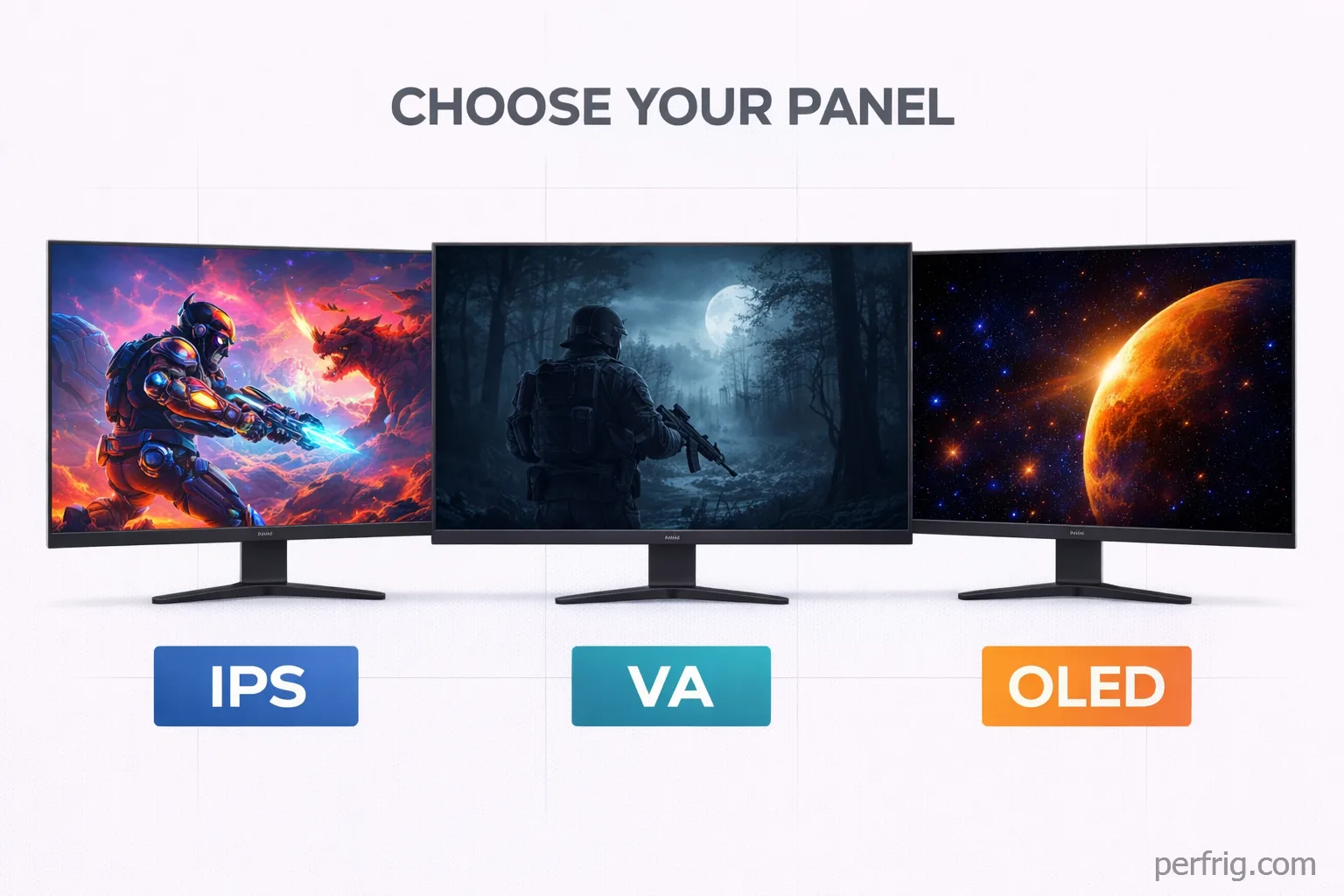
Choosing the right panel technology matters more than most gamers realize. Two 1440p 165Hz monitors can deliver completly different visual experiences depending on whether they use IPS, VA, or OLED panels. Panel type determines color accuracy, contrast ratio, response times, and viewing angles—the fundamentals of image quality that resolution and refresh rate alone can’t fix.
Our previous display guides covered refresh rates and input lag. Display Part 1 explained how refresh rates impact gaming smoothness and which Hz targets matter for different genres. This guide completes the trilogy by explaining panel technologies and helping you match the right panel to your gaming priorities. Whether you prioritize competitive performance, cinematic visuals, or balanced versatility, understanding these differences prevents expensive purchasing mistakes.
How panel types work
All LCD panels—IPS, VA, and TN—use liquid crystals and backlights to create images. The difference lies in how those crystals align and twist to control light. IPS arranges crystals parallel to the screen for wide viewing angles. VA aligns crystals vertically for superior contrast. TN uses twisted crystals for fast response times but sacrifices image quality.
OLED works entirely differently. Each pixel generates its own light through organic compounds, eliminating the backlight entirely. This fundamental difference enables OLED’s perfect blacks and near-instant response times but introduces burn-in concerns and higher costs.
The panel choice creates trade-offs. IPS delivers accurate colors with weaker contrast. VA provides deep blacks with slower response times. OLED achieves both strengths while costing significantly more. Understanding these compromises helps match panels to your specific gaming needs.
IPS: the balanced all-rounder
IPS panels dominate the gaming market for good reason. Modern IPS delivers 95-100% sRGB color coverage while supporting high refresh rates up to 360Hz. Response times have improved dramatically, with premium IPS achieving 1ms gray-to-gray speeds.
The main IPS strength lies in viewing angles. Colors remain accurate up to 178 degrees, ideal for multi-monitor setups or off-center viewing. Content creators appreciate this consistency—colors don’t shift when you adjust position.
IPS weaknesses center on contrast. Most IPS panels deliver 1000:1 ratios, producing grayish blacks. “IPS glow” becomes visible in dark scenes, particularly in darkened rooms where panel edges appear brighter.
For gaming, IPS excels in competitive scenarios. Fast response times maintain motion clarity in shooters. Accurate colors help spot enemies. This combination makes IPS the safe default for most gamers.
VA: contrast kings at budget prices
VA panels deliver highest LCD contrast, typically 2500:1 to 4000:1. Some premium VA monitors exceed 5000:1, approaching OLED-level blacks without organic panel costs. This creates more immersive visuals in dark scenes—caves, space, nighttime gain genuine depth.

Superior contrast makes VA ideal for cinematic single-player games. Titles like Cyberpunk 2077 or Elden Ring benefit from VA’s deep shadows alongside bright highlights.
VA’s primary weakness involves response times. Pixel transitions take longer than IPS or OLED, creating ghosting during fast motion. Competitive players notice trails in fast-paced shooters.
Viewing angles represent another compromise. Colors shift off-center, though modern VA improved significantly. For single-user straight-on viewing, this matters less.
OLED: premium performance with caveats
OLED represents the display pinnacle. Each pixel emits own light, enabling infinite contrast—pixels turn completely off for perfect blacks. Response times approach 0.1ms, faster than any LCD. Motion clarity remains unmatched.
Color reproduction exceeds premium IPS panels. Perfect blacks plus vibrant colors create HDR experiences LCD struggles to match. Bright explosions against black space display with impact backlights can’t replicate.
OLED’s main concern involves burn-in risk. Static HUDs or taskbars can permanently ghost into panels. Modern OLED monitors include pixel shift and refresh cycles mitigating burn-in with proper habits.
Peak brightness limits OLED. Most reach 250-400 nits full-screen, less than high-end IPS hitting 600-1000 nits. In bright rooms, OLED appears dimmer.
Price remains the biggest barrier. OLED gaming monitors cost $800-1500+ versus $200-400 for IPS or VA.
Response times and motion clarity
Response time measures how quickly pixels transition between colors. Faster response times reduce motion blur and ghosting during fast action. OLED leads dramatically at ~0.1ms true response. Premium IPS panels achieve 1-2ms gray-to-gray. VA panels typically measure 4-8ms, with dark transitions often slower.

These measurements translate to real gaming experiences. OLED and fast IPS panels deliver crisp motion in 165Hz+ scenarios. Objects moving across the screen maintain sharp edges. VA panels show noticeable smearing in competitive shooters where tracking fast-moving targets matters.
Motion clarity depends on both response time and refresh rate working together. A 1ms IPS panel at 240Hz provides excellent clarity. A 5ms VA panel at 240Hz struggles because pixel transitions can’t complete quickly enough between frames, creating persistent motion blur.
For competitive gaming, prioritize fast response times. Casual and single-player gaming tolerates slower VA response times, especially when contrast and visual quality matter more than split-second clarity.
Choosing by gaming genre
Competitive FPS and esports titles benefit most from fast IPS panels. The combination of quick response times, high refresh rate support, and accurate colors helps maintain visibility during intense action. VA ghosting and OLED costs rarely justify themselves for pure competitive play.
Story-driven and open-world games shine on VA or OLED panels. The superior contrast creates more immersive environments. Exploring atmospheric worlds in games like Starfield, Red Dead Redemption 2, or Horizon Forbidden West gains depth from genuine black levels. Visual fidelity matters more than split-second response in these scenarios.
Mixed gaming libraries benefit from IPS versatility. Playing competitive shooters one day and cinematic adventures the next requires balanced performance. IPS delivers adequate contrast for single-player games while maintaining the speed needed for competitive matches.
HDR gaming specifically favors OLED or high-end Mini-LED IPS. The contrast range necessary for impactful HDR requires either perfect OLED blacks or exceptional LCD dimming zones. Budget VA and standard IPS panels lack the dynamic range to properly display HDR content.

Common panel mistakes
Buying VA for competitive gaming represents the most frequent error. The slower response times create genuine disadvantages in fast-paced multiplayer. Players blame their skills when the monitor introduces motion blur their opponents don’t experience.
Ignoring IPS glow before purchasing creates disappointment. Some users find IPS glow intolerable in dark rooms, particularly on larger 27″+ displays. Testing monitors in your actual room lighting prevents this surprise.
OLED fear without understanding burn-in risk causes some gamers to dismiss the technology entirely. Modern OLED monitors with proper usage habits handle gaming perfectly well. Varying content, using dark modes, and enabling protective features manage burn-in risk effectively for most users.
Prioritizing refresh rate over panel quality creates mismatched expectations. A 240Hz VA monitor won’t deliver the motion clarity of a 165Hz IPS panel due to response time differences. Panel technology matters more than raw refresh rate numbers in many scenarios.
The bottom line
Panel technology determines how games actually look and feel regardless of resolution or refresh rate specifications. IPS provides the safest all-around choice with balanced performance, accurate colors, and fast response times suitable for competitive and casual gaming. VA delivers superior contrast and value for immersive single-player experiences at the cost of slower response times. OLED achieves the best overall image quality with perfect blacks and instant response but requires higher budgets and burn-in awareness.
Your gaming priorities determine the right choice. Competitive players need fast IPS response times. Cinematic gamers benefit from VA or OLED contrast. Mixed libraries work best with versatile IPS panels. Budget constraints often push toward VA for maximum visual impact per dollar, while enthusiasts justify OLED premiums for unmatched image quality.
No panel technology excels at everything. Understanding these trade-offs prevents expensive mistakes and ensures your monitor actually enhances your gaming experience rather than creating compromises you didn’t expect.











Join the Discussion