
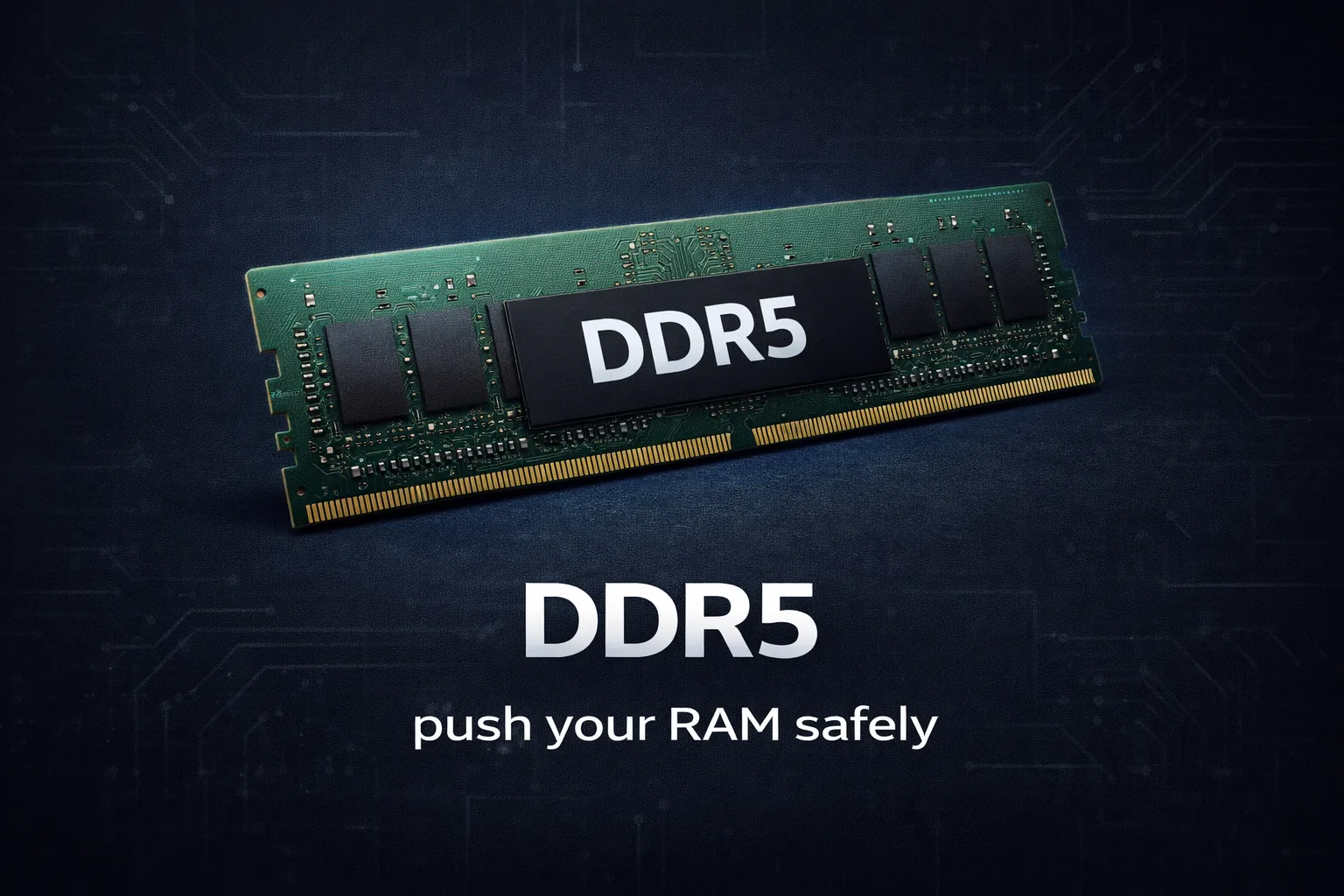
XMP, EXPO, manual timings, and knowing exactly when to stop.
Most people install DDR5 and never touch the settings. That works fine, but you are probably leaving real performance on the table. Here’s where it gets interesting: DDR5 overclocking is more accessible than it has ever been, and for a lot of builds, a few minutes in the BIOS translates directly into better frame times and faster load speeds. This guide walks you through every step from XMP to manual tuning, and covers the key differences between Ryzen and Intel behavior so you are not guessing.
Start here: XMP and EXPO
Before touching any manual settings, enable XMP or EXPO first. This is the baseline.
XMP (Extreme Memory Profile) is Intel’s standard. EXPO (Extended Profiles for Overclocking) is AMD’s equivalent. Both do the same thing: they load a manufacturer-tested profile stored on your RAM stick that runs it at its advertised speed instead of the default JEDEC standard, which on DDR5 is typically 4800 MT/s.
If your kit is rated for DDR5-6000 and you are running at 4800, you have not gotten what you paid for yet. Enable XMP or EXPO in BIOS and reboot. That single change is the best return on time investment in PC building.
A few kits include multiple XMP profiles at different speeds and voltages. If yours does, start with the lower profile and test stability before jumping to the highest. Most kits are fine at their advertised speed, but defintely worth confirming before moving on.
Manual overclocking: when and why
XMP gets you most of the way there. Manual tuning is for pushing further, or for fixing instability that XMP sometimes introduces.
The two levers you are working with are frequency and timings. Higher frequency generally means more bandwidth. Tighter timings mean lower latency. The two are in tension: pushing frequency usually requires loosening timings to maintain stability, and tightening timings often means dropping frequency slightly. The right choice depends on what you are optimizing for.
For gaming, latency matters more than raw bandwidth. Tighter timings at moderate frequency (DDR5-6000 with CL30) typically outperforms higher frequency with looser timings (DDR5-7200 with CL36) in most gaming workloads. For content creation and memory-intensive tasks, bandwidth wins and higher frequency with acceptable timings is the better call.
Primary timings to understand: CL (CAS Latency) is the most quoted number and the most impactful. tRCD and tRP follow closely. These three together determine the majority of your memory’s latency characteristics. Secondary and tertiary timings matter, but I’ve seen people spend hours chasing gains of half a nanosecond when the primary timings were still loose. Fix the primaries first.
Ryzen vs Intel: behavior is different
This is where a lot of guides skip important context. DDR5 behaves differently depending on your platform.
Intel platforms are generally more flexible with high-frequency kits. DDR5-7200 and above is reachable on many Intel builds without significant effort. The memory controller on recent Intel CPUs handles aggressive frequencies well.
Ryzen is more nuanced. AMD’s Infinity Fabric has a recommended sweet spot at DDR5-6000 on Ryzen 7000 series, because the fabric clock runs at half the memory frequency. At DDR5-6000, the fabric hits 3000 MHz which is its optimal range. Push above DDR5-6000 on Ryzen and the fabric either decouples (losing latency benefits) or you need to manually increase FCLK, which adds complexity and heat.
For most Ryzen builders, DDR5-6000 CL30 is the actualy sweet spot and rarely worth pushing further. For Intel, the ceiling is higher and the tradeoffs are less severe.
Stability testing
Never skip this step. Running RAM that appears stable but is not causes crashes, corrupted files, and the kind of intermittent errors that are extremely frustrating to diagnose.
The standard tool is TestMem5 with the anta777 Extreme profile. Run it for at least two passes, ideally four. A single pass takes roughly 20 to 30 minutes depending on kit size. If you see any errors, the overclock is not stable and needs adjustment.
For a more thorough check, Karhu RAMTest is the more demanding option. One hour at 500% coverage is the benchmark most overclockers use before considering a result confirmed stable.
Common causes of instability: voltage is too low for the frequency you are targeting, primary timings are too tight for your specific chips, or the IMC (memory controller) on your CPU has limits that your settings are exceeding. DDR5 kits using Hynix A-die, Samsung B-die, or Micron chips all have different overclocking characteristics. If you know your chip type, you can find community-tested profiles that serve as reliable starting points.
Voltage: what is safe
DDR5 stock voltage is 1.1V. XMP profiles typically run at 1.25V to 1.35V for higher-speed kits. Manual overclocking often goes up to 1.4V without concern. Beyond 1.45V you are in territory where longevity questions start to arise, though the actual risk is low for daily use.
Keep an eye on VDD and VDDQ voltages specifically. Some motherboards let you set these independently. Running VDDQ slightly lower than VDD (by about 0.1V) is a common approach that helps stability without adding unnecessary heat.
When to stop pushing
Here’s the honest answer: stop when the time investment stops making sense.
Going from stock 4800 to XMP 6000 is a five-minute BIOS change with measurable impact. Going from 6000 CL30 to 6000 CL28 takes hours of testing for gains you will not notice in games. Going from 6000 to 6400 on Ryzen requires decoupling the fabric, which can actually hurt real-world performance even if benchmarks improve.
For most builders, the target is DDR5-6000 CL30 on Ryzen and DDR5-6400 to 6800 with reasonable timings on Intel. Everything beyond that is diminishing returns unless you are specifically chasing benchmark numbers or running memory-bound workloads at a professional level.
Enable XMP, verify stability, and move on. That is the recomendation for 90% of builds.














Join the Discussion