

| Category | Details |
|---|---|
| Pros | 32 Xe2 cores, 16 GB GDDR6, 256-bit bus, XeSS 3 MFG ready, B580 proved drivers actually work now |
| Cons | Not launching as a gaming GPU, canceled due to financial concerns, B580 owners left waiting for a flagship |
| Verdict | SKIP (it doesn’t exist) |
| Score | N/A |
Look, here’s what you actually need to know. Intel built the B770. The silicon is real. The drivers are ready. The specs leaked cleanly across multiple sources. And then Intel pulled the plug on the gaming version entirely, redirecting the same chip toward workstation and AI markets. That’s the story. Everything else is context.
This is not a traditional review because there is no card to buy. It is a verdict on what Intel had, what they chose not to release, and what that means if you were waiting for Big Battlemage to fill the mid-range gap.
what intel actually built
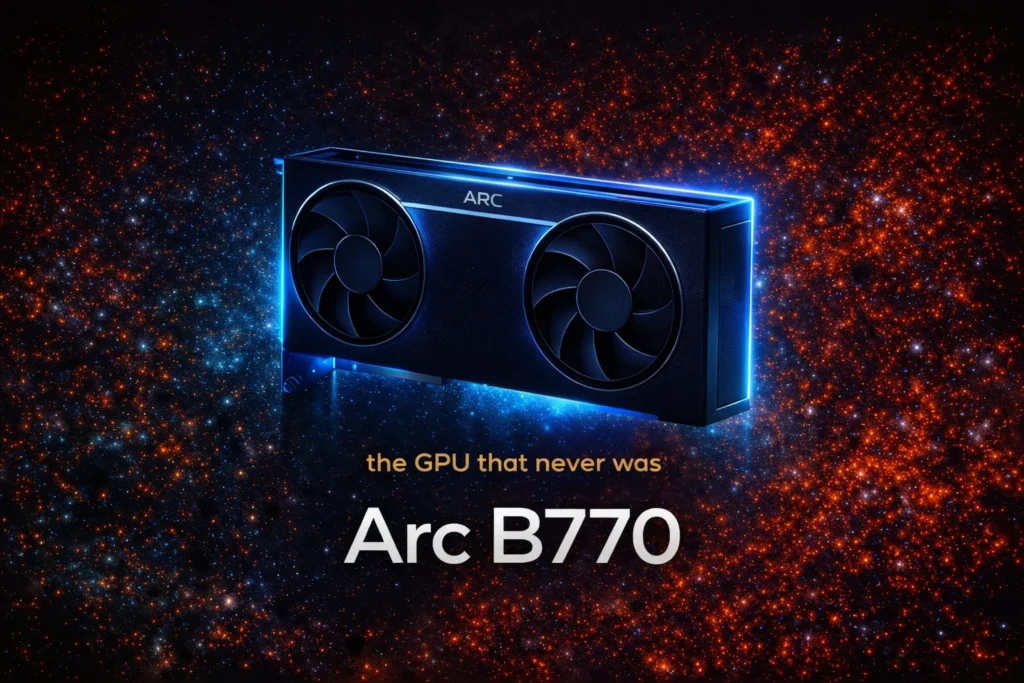
The B770 is powered by the BMG-G31 die: 32 Xe2 cores, a 256-bit memory bus, 16 GB of GDDR6, and a TDP reported at 300W. That is a substantial step up from the B580’s 20 Xe2 cores, 190W, and 12 GB on a narrower bus. Based on architectural scaling, performance projections placed it somewhere between an RTX 4070 and RTX 5070 in rasterization, with 60 percent more raw compute than the B580.
The 16 GB VRAM was the other headline. At a rumored price of $400 to $450, Intel would have been offering more memory than competing cards in the same performance class. The RX 9060 XT ships with either 8 GB or 16 GB depending on variant and current market pricing. The RTX 5060 Ti uses 12 GB. A 16 GB B770 at a competitive price would have been a legitimate disruptor.
Real talk: the paper specs were good. This was not a card that would have embarrassed Intel. The problem was never the hardware.
why it didn’t launch
Here’s the problem. The DRAM shortage hit in 2026 hard enough that releasing a 16 GB consumer GPU at a sensible price became basically impossible. The same memory crisis pushed RX 9060 XT prices above MSRP and created stock constraints across the market. For Intel, launching the B770 would have meant either pricing it out of the value range that made the B580 compelling, or taking a loss on a product category where their market share sits below one percent.
The validation costs, board partner coordination, marketing spend, and ongoing driver maintenance do not scale well when you are Intel competing in a space where NVIDIA and AMD have decades of brand loyalty. According to reports from Igor’s Lab and corroborated by XDA Developers, Intel deemed the gaming B770 “not financially viable.” The same BMG-G31 silicon now lives inside the Arc Pro B70, a workstation card with 32 GB of VRAM aimed squarely at AI workloads.
That’s not nothing. But it’s not enough for the gamers who were waiting.
XeSS 3 and the software story that actually landed
The one area where Intel genuinely delivered is software. XeSS 3 with Multi-Frame Generation rolled out in February 2026 to all Battlemage and Alchemist GPUs via driver version 32.0.101.8509. Any game that already supports XeSS 2 frame generation gets MFG support through an override in Intel’s Graphics Software app. Up to 3:1 frame insertion, no developer update required.
That is a meaningfully better implementation story than AMD’s FSR approach, which as of early 2026 still lacks native multi-frame generation in the same way. In games with XeSS 2 support, B580 users can turn on 2x or 3x MFG and see substantial framerate increases. The 4x mode introduces noticeable input lag, but 2x and 3x are useable in non-competitive titles.
The XeSS 3 SDK released March 9, 2026, adds 3x and 4x modes with improved frame pacing and UI stability. Developer adoption is still Intel’s biggest hurdle, XeSS sits third behind DLSS and FSR in game support, but the driver-level override means existing support goes further than it used to.
The B770 would have launched into this software ecosystem. That matters because the Battlemage generation is the first Arc generation where the software story is not itself a reason to avoid the hardware.
the value comparison Intel forfeited
Let’s be honest about what you’re paying for in this segment right now.
| GPU | VRAM | Est. Street Price | Performance tier |
|---|---|---|---|
| RX 9060 XT 16 GB | 16 GB | $390-430 | 1080p/1440p capable |
| RTX 5060 Ti 12 GB | 12 GB | $430-480 | 1080p/1440p capable |
| Arc B770 (projected) | 16 GB | $400-450 | RTX 4070 class |
| Arc B580 | 12 GB | $250-280 | RTX 4060 class |
The B770 projection put it at comparable performance to the RTX 4070 range with 16 GB VRAM at a price undercut by about 10 to 15 percent. That is the slot where it would have sat. Against the RX 9060 XT, it would have competed on VRAM and potentially on rasterization performance. Against the RTX 5060 Ti, it would have led on memory while trading blows on framerate depending on the title.
That competitiveness is exactly why the cancellation stings. Intel had the specs to be disruptive at this tier. What they didn’t have was the market position to absorb the launch costs in a memory-crisis environment.
bottom line
The B770 as a gaming GPU is dead. What Intel built was real, the performance projection was solid, and the software stack finally had its act together. The combination of a DRAM shortage, sub-one-percent market share, and the more profitable pull of the AI workstation market made the business case collapse.
If you are looking for a mid-range GPU right now, the RX 9060 XT 16 GB is genuinely the card the B770 would have competed against most directly, and it’s worth considering. The B580 at $250 remains the only Intel option in the market, and it still performes well at 1080p and light 1440p workloads.
The B770 story is not about a bad GPU. It’s about a GPU that would have been genuinly competitive, launched into the wrong market at the wrong time, by a company that couldn’t afford to fight the battle even with the right weapon.
SKIP. Not because it’s bad. Because you can’t buy it.
Sources and Further Reading










Join the Discussion