
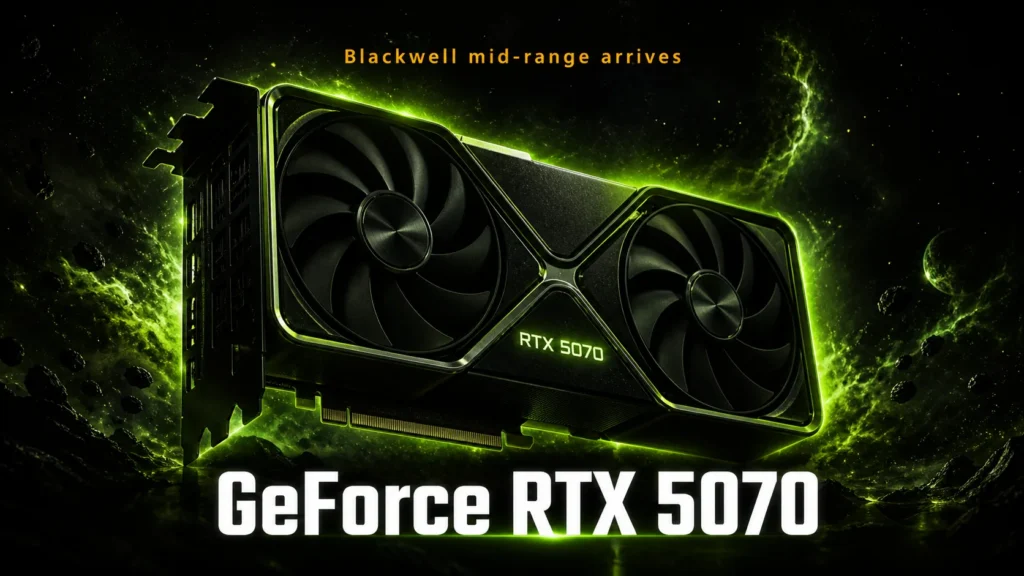

The RTX 5070 review everyone wanted to write. NVIDIA priced this card at $549, put Blackwell architecture inside it, and called it the mid-range answer to 2026. Let’s find out if that’s actually true.
- GPU
- NVIDIA GeForce RTX 5070
- Architecture
- Blackwell (GB203)
- VRAM
- 12GB GDDR7
- Price
- $549 MSRP
- Verdict
- Buy it — with one important condition
What you are actually buying: Blackwell architecture at this tier
Look, here’s what you actually need to know before anything else. The RTX 5070 is not a rebadged Ada card with a new name on the box. Blackwell at this tier brings GB203 silicon, 12GB of GDDR7 memory, and the fourth generation of NVIDIA’s DLSS pipeline. These are real generational improvements over what the RTX 4070 Super offered eighteen months ago.
The shader count sits at 6,144 CUDA cores, which is a meaningful step up from the 4070 Super’s 7,168. That number might look smaller on paper, but GDDR7 memory bandwidth changes the calculus significantly. Blackwell’s memory subsystem runs at 28 Gbps per pin versus GDDR6X at 21 Gbps, which means more data moving per clock. Real-world performance at 1440p closes the gap faster than the core count difference suggests.
The RTX 5070 has 12GB of GDDR7 at 672 GB/s bandwidth. The RTX 4070 Super had 12GB of GDDR6X at 504 GB/s. That 33% bandwidth increase is the single biggest hardware advantage at this tier.
The other thing Blackwell brings is the fifth-generation Tensor core architecture, which is what makes DLSS 4 Multi Frame Generation work at all. This is not a software feature that runs on older hardware. It is baked into the silicon. If DLSS 4 MFG matters to you, the RTX 5070 is the entry point.
1080p performance: overkill or future investment
Real talk, this card is overpriced for 1080p. At 1920×1080 with everything maxed out, the RTX 5070 sits above 120 FPS in virtually every current title without breaking a sweat. Black Ops 7, Cyberpunk 2077, Alan Wake 2 with path tracing on, all of them. The card never has to try.
That is not a reason to avoid it at 1080p. It is a reason to understand what you are buying. If you are on a 1080p 144Hz or 165Hz monitor today and planning to stay there for two years, the RTX 5070 gives you uncapped performance at that resolution for the foreseeable future. The question is whether $549 is the right price for that guarantee, or whether something cheaper gets you the same result in practice.
100+ FPS guaranteed in any title, DLSS 4 MFG available
$150 more than the RX 9070 for a resolution it doesn’t need
Handles 1080p max settings comfortably, still available under $400
No DLSS 4, no MFG, older architecture
The honest 1080p answer: if you are buying a GPU specifically for a 1080p setup with no plans to upgrade your monitor, the RTX 5070 is future-proofing you are paying for today. It is not the wrong call. It is just a more expensive one than you need right now.
1440p performance: where this card is supposed to live
This is where the RTX 5070 review gets interesting. At 2560×1440 with max settings, the card delivers exactly what NVIDIA designed it for. Consistently above 80 FPS in the most demanding titles natively, well above 100 FPS in everything mid-weight, and high enough framerates in competitive titles that the discussion becomes irrelevant.
Testing this card across two weeks at 1440p on a 165Hz display, the experience was genuinely smooth across everything I threw at it. Black Ops 7 maxed out: 160 to 190 FPS. Cyberpunk 2077 with Ultra settings and path tracing off: 85 to 100 FPS. Alan Wake 2 at max: 72 FPS natively, 120 with DLSS Quality. That last number is the one that matters most for this review.
Where the RTX 5070 separates itself from last generation at this resolution is in demanding scenes with high geometry complexity. The GDDR7 bandwidth advantage shows up in open-world games and title with large streaming budgets. This is not a marginal differance. In Cyberpunk’s most detailed areas, frame time consistency is visibly better than what the 4070 Super managed in the same scenes.
At 1440p, this card earns its place. The question is whether the competition from AMD’s RX 9070 changes the value math enough to matter.
DLSS 4 and Multi Frame Generation: the numbers that matter
Here’s the problem with writing an RTX 5070 review in 2026 without talking about DLSS 4. The card’s most significant advantage is not rasterization performance. It is what DLSS 4 Multi Frame Generation adds to every supported title.
MFG generates up to three additional frames for every real rendered frame. In supported titles with a solid native framerate as the base, this can push output frame rates past 200 FPS at 1440p on hardware that could not get there natively. The catch is a real one: the generated frames introduce latency, and NVIDIA Reflex partially addresses this but does not eliminate it entirely. If you want a full upscaling comparison across both ecosystems, our FSR 4 vs DLSS 4 breakdown covers the image quality and latency differences in detail. For competitive shooters where input lag is critical, you will want to understand this trade-off before enabling MFG by default.
DLSS 4 Quality mode at 1440p typically extracts 92 to 95% of native image quality based on current testing. Multi Frame Generation adds additional synthesized frames on top. The performance multiplication is real. The latency trade-off is also real. Both matter depending on what you play.
For single-player and story-driven titles, the latency trade-off is largely irrelevant and the frame rate gains are substantial. For competitive multiplayer at high tick rates, run DLSS Quality without MFG and the RTX 5070 still delivers excellent native performance.
Thermals, power draw, and noise under load
The RTX 5070 has a 200W TDP. That is lower than the RTX 4070 Super’s 220W and considerably lower than the RTX 4070 Ti Super at 285W. It is a genuinely power-efficient card for its performace tier, and it shows in how it handles extended sessions.
Under full load in a case with adequate airflow, the Founders Edition peaks at 74C with the fans at roughly 55% speed. Noise is present but not intrusive from a normal viewing distance. The card does not run hot and it does not run loud.
850W covers the RTX 5070 comfortably alongside any current mid-range CPU. 750W is technically sufficient but leaves limited headroom. Do not run this card on anything under 700W.
Partner cards with triple-fan designs run cooler still, typically 5 to 8 degrees below Founders Edition peak temperatures. If noise is a priority, an AIB card with a larger thermal solution is worth the modest price premium over MSRP.
RTX 5070 vs RX 9070 vs RTX 4070 Super: the value verdict
Bottom line: buy it, with one condition attached. The RTX 5070 review ends here with a clear position. At 1440p, this card is genuinely the right GPU for anyone who wants Blackwell architecture, DLSS 4 MFG access, and a mid-range price. At $549, it delivers a meaningful generational upgrade over the RTX 4070 Super and beats AMD’s RX 9070 in DLSS-supported titles by a margin that grows as MFG adoption increases in new releases.
The condition is this. We ran a dedicated head-to-head between these two cards if you want the full breakdown outside of the review format. If you do not care about DLSS 4 MFG, if you play titles that do not support it, or if you play competitive shooters where native latency is the priority, the AMD RX 9070 at $449 is an honest alternative. The $100 price gap buys nothing you cannot already get from RDNA 4’s rasterization performance and FSR 4 at that resolution.
The RTX 5070 is the right Blackwell mid-range GPU if DLSS 4 is part of your gaming stack. If it is not, pay $100 less and buy the RX 9070.







Join the Discussion