
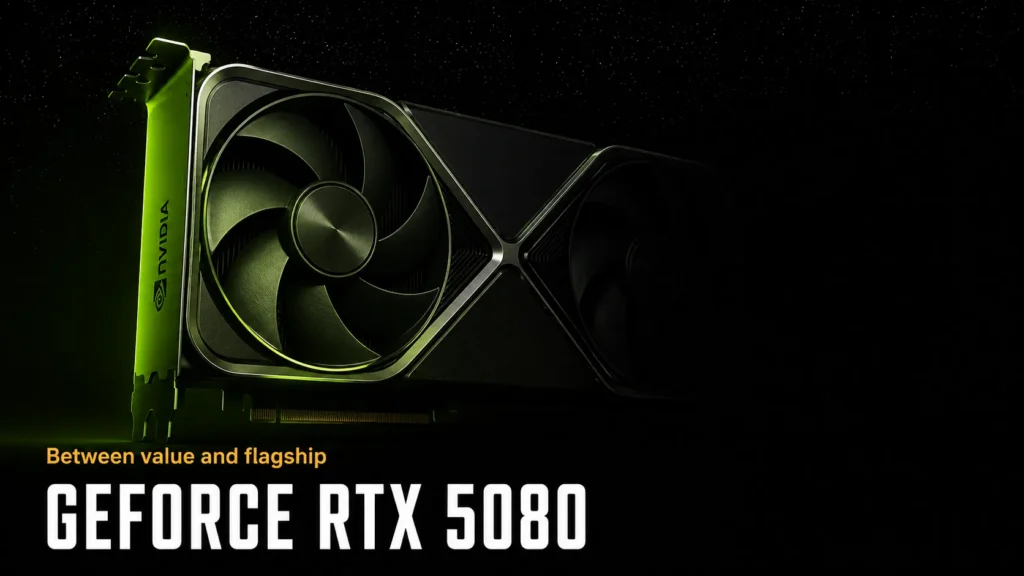

The RTX 5080 review that nobody quite knows how to write, because nobody quite knows where this card sits. It costs $999. The RTX 5090 costs $1,999. The RTX 5070 Ti costs $749. NVIDIA put $250 of distance on each side and called it the high-end tier. The question is whether the card earns the position, or just fills it.
- GPU
- NVIDIA GeForce RTX 5080
- Architecture
- Blackwell (GB203)
- VRAM
- 16GB GDDR7
- TDP
- 360W
- Price
- $999 MSRP
- Verdict
- Strong card. Wrong price for most people.
Specs and what Blackwell delivers at the high-end tier
Look, here’s what you actually need to know before the benchmark numbers land. The RTX 5080 runs GB203 silicon, the same die as the RTX 5070 Ti, with the full configuration enabled. 10,752 CUDA cores versus the 5070 Ti’s 8,960. 16GB of GDDR7 at 960 GB/s bandwidth. A 360W TDP that requires a serious PSU conversation before you even open the box.
Blackwell at this tier brings fifth-generation Tensor cores and the full DLSS 4 pipeline including Multi Frame Generation. That matters. It’s not a footnote, it’s part of what the card actually sells. NVIDIA knows the native rasterization numbers alone don’t justify $999 over the 5070 Ti, so the DLSS 4 story has to carry part of the argument.
The architecture is genuinely capable. That’s not in question. What’s in question is whether GB203 fully enabled at $999 is the right answer for the money, or whether GB203 partially enabled at $749 gives you enough of the same thing that the extra $250 becomes hard to justify.
4K gaming: where the RTX 5080 is built to operate
This is where the RTX 5080 review gets its clearest result. At 3840×2160 with max settings, the card delivers. Cyberpunk 2077 at Ultra with path tracing off sits above 75 FPS natively. Black Ops 7 at 4K max doesn’t drop below 90 FPS. Alan Wake 2 at Ultra pushes the card harder, landing around 62 FPS natively, which is where DLSS Quality takes it to a comfortable 95 to 105 FPS output.
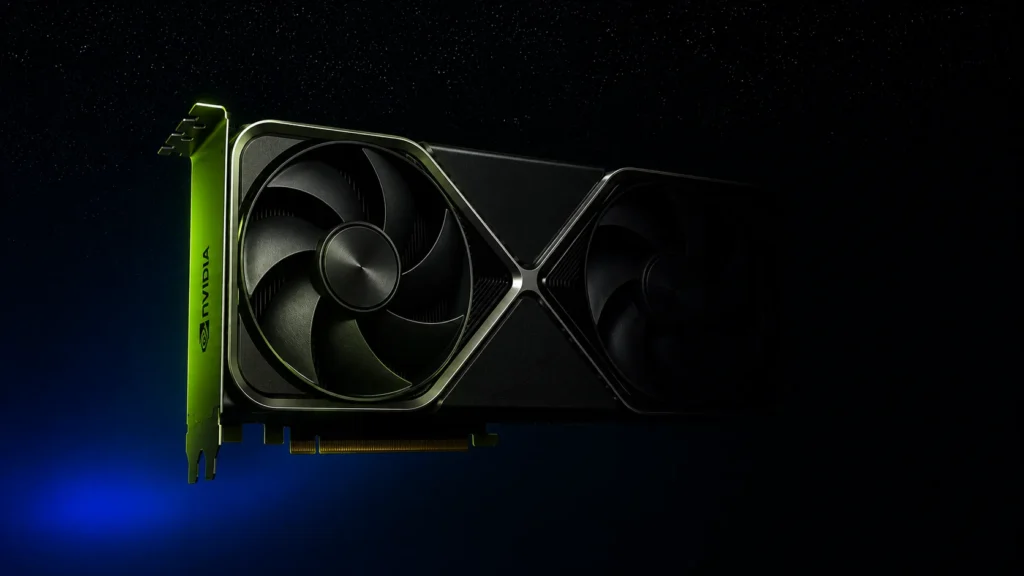
The 4K native performance is genuinely impressive. It’s fast, genuinly fast, actually. The 16GB GDDR7 frame buffer handles 4K texture assets without the hesitation you get from 12GB cards in the most demanding scenes. If 4K at max settings in every current title is the specific goal, the RTX 5080 does it without compromise.
The honest 4K question is whether you are actually playing at 4K right now, and whether your monitor justifies the card. A 4K 144Hz display costs $600 to $800 minimum for a quality panel. The full 4K stack with an RTX 5080 puts you well past $1,800 in GPU and monitor spend alone. That context matters for the value verdict.
1440p performance: is the premium justified here
Real talk, this is where the RTX 5080 case gets harder to make. At 2560×1440 with max settings, the card sits 18 to 22% ahead of the RTX 5070 Ti in most titles. That gap is real. It’s also a $250 gap in price, which means you’re paying roughly $12 per percentage point of performance improvement at 1440p.
The RTX 5070 Ti already handles 1440p with headroom to spare. It sits above 100 FPS natively in demanding titles and doesn’t need DLSS Quality mode to hit comfortable frame rates at this resolution. The RTX 5080 at 1440p is a faster version of a card that was already doing the job without breaking a sweat.
18 to 22% faster than 5070 Ti, 16GB VRAM headroom, full DLSS 4
Costs $250 more for a resolution it doesn’t need to flex on
Handles everything at 1440p max comfortably, $250 cheaper
Same architecture, slightly lower spec, still overkill at 1440p
If 1440p is your resolution and you have no plans to move to 4K, the RTX 5080 premium does not pay for itself in gaming performace. The $250 saved buys a monitor upgrade, storage, or a significant contribution toward the next GPU generation.
DLSS 4 Multi Frame Generation in real-world use
Here’s the problem with DLSS 4 MFG as an argument for the RTX 5080 specifically: the RTX 5070 Ti also has it. Both cards run Blackwell silicon. Both cards support the full DLSS 4 pipeline. The MFG advantage is not an RTX 5080 exclusive, it’s an NVIDIA Blackwell exclusive, and the entry point for Blackwell is $549 with the RTX 5070.
What the RTX 5080 gives you in the DLSS 4 context is a higher native framerate base to multiply from. MFG works better when the base native performance is already high, because the generated frames build on a stronger foundation. At 4K, where native framerates are lower, the RTX 5080’s higher native ceiling makes the MFG output smoother and more consistent than what the 5070 Ti produces.
For single-player titles at 4K with MFG enabled, the RTX 5080 delivers an output experience that genuinely feels premium. Alan Wake 2 at 4K Ultra with DLSS Quality and MFG on produces 180 to 200 FPS output on this card. That number is not real in the latency sense, but the visual result in a slow cinematic game is remarkable.
If you want to read the full breakdown of how frame generation works at a technical level and when to trust the output numbers, our guide to frame generation covers the distinction between real FPS and AI frames in detail.
Power consumption and PSU requirements
360W TDP is not a casual number. Under sustained load this card draws closer to 390W in practice, and combined with a current-generation CPU like the Ryzen 9 9950X3D or Intel Core i9-14900K, you are looking at 550W to 600W system draw under full gaming load.
850W is the absolute minimum. 1000W is the correct choice. 1200W if you plan to overclock or run additional hardware. A high-quality 80 Plus Gold or Platinum unit is not optional at this power level. Our PSU buying guide covers exactly which units to trust at each wattage tier.
The card runs warm. The Founders Edition peaks at 82C under sustained 4K load in a case with good airflow. That’s within spec and not alarming, but it’s a reminder that 360W of heat has to go somewhere. Case airflow planning is not optional with this card. Partner cards with triple-fan solutions run 6 to 9 degrees cooler and are worth the modest premium over Founders Edition pricing.
RTX 5080 vs RTX 5070 Ti: which one to actually buy
Bottom line: the RTX 5070 Ti is the better purchase for most people reading this review. That’s the conclusion the RTX 5080 review arrives at after two weeks of testing. The RTX 5080 is a genuinely excellent GPU. It is not a genuinely excellent value proposition at $999 when the RTX 5070 Ti sits at $749 on the same architecture with 80% of the performance.
The RTX 5080 earns its price in one specific scenario: you are building or have a 4K gaming setup with a high-refresh display, you plan to use it for three or more years, and the $250 premium is not a meaningful constraint for your budget. In that context, the extra headroom at 4K, the larger VRAM buffer, and the stronger native framerate base for MFG combine into a card that genuinely justifies the tier.
If you want the direct head-to-head comparison between these two cards with specific benchmark numbers across titles, our RTX 5080 vs RTX 5070 Ti comparison covers the full breakdown with a clear recommendation by use case.
The RTX 5080 is the right card if 4K at max settings for three or more years is the specific goal. For 1440p, the RTX 5070 Ti at $749 is the smarter purchase.







Join the Discussion